



ADM’s Company Overview
Archer Daniels Midland Company (ADM) is a preeminent player in the global food processing and commodities trading industry, headquartered in...
Archer Daniels Midland Company (ADM) is a preeminent player in the global food processing and commodities trading industry, headquartered in Chicago, Illinois. ADM's mission is to unlock the power of nature to enrich the quality of life, addressing the world's critical needs for food and renewable energy. As one of the largest processors of oilseeds, corn, wheat, and other agricultural commodities, ADM specializes in manufacturing a myriad of products, including protein meal, vegetable oil, corn sweeteners, flour, biodiesel, ethanol, and various other value-added food and feed ingredients. Through its expansive network of innovation centers and production facilities worldwide, ADM leverages its expertise to craft ingredients and solutions that cater to the evolving needs of its diverse clientele, ranging from food manufacturers to energy producers.
ADM's distinctive business model revolves around the vertical integration of its operations, encompassing the entire agricultural value chain from origination to processing and distribution. The company maintains an extensive global network of grain elevators and transportation infrastructure, which enables the efficient procurement, storage, cleaning, and transportation of agricultural commodities. By owning and operating these critical assets, ADM can ensure the reliability and quality of its supply chain, thereby providing unmatched service and product consistency to its customers. Furthermore, ADM invests heavily in research and development, continually innovating to offer new and enhanced products designed to meet the stringent demands of today's market while promoting sustainability and operational efficiency.
Revenue generation at ADM is multifaceted, with income streams emanating from various segments of its vast operations. Primarily, the company earns through the sale of its processed agricultural products, such as protein meal, vegetable oils, and ethanol, to numerous industries including food, beverage, animal feed, and biofuel manufacturers. Additionally, ADM generates revenue through its logistics services, encompassing the transportation and storage of raw and processed commodities. By integrating its processing capabilities with a robust transportation network, ADM not only reduces costs but also creates additional revenue opportunities through third-party logistics services. The company’s diversified portfolio and geographically dispersed operations ensure a balanced revenue model that mitigates risks and sustains growth across fluctuating market conditions.
Headquater: Chicago, Illinois, US
-
Foundations date: 1902
-
Company Type: Public
-
Sector: Industrials
-
Category: Agriculture
-
Digital Maturity: Conservative
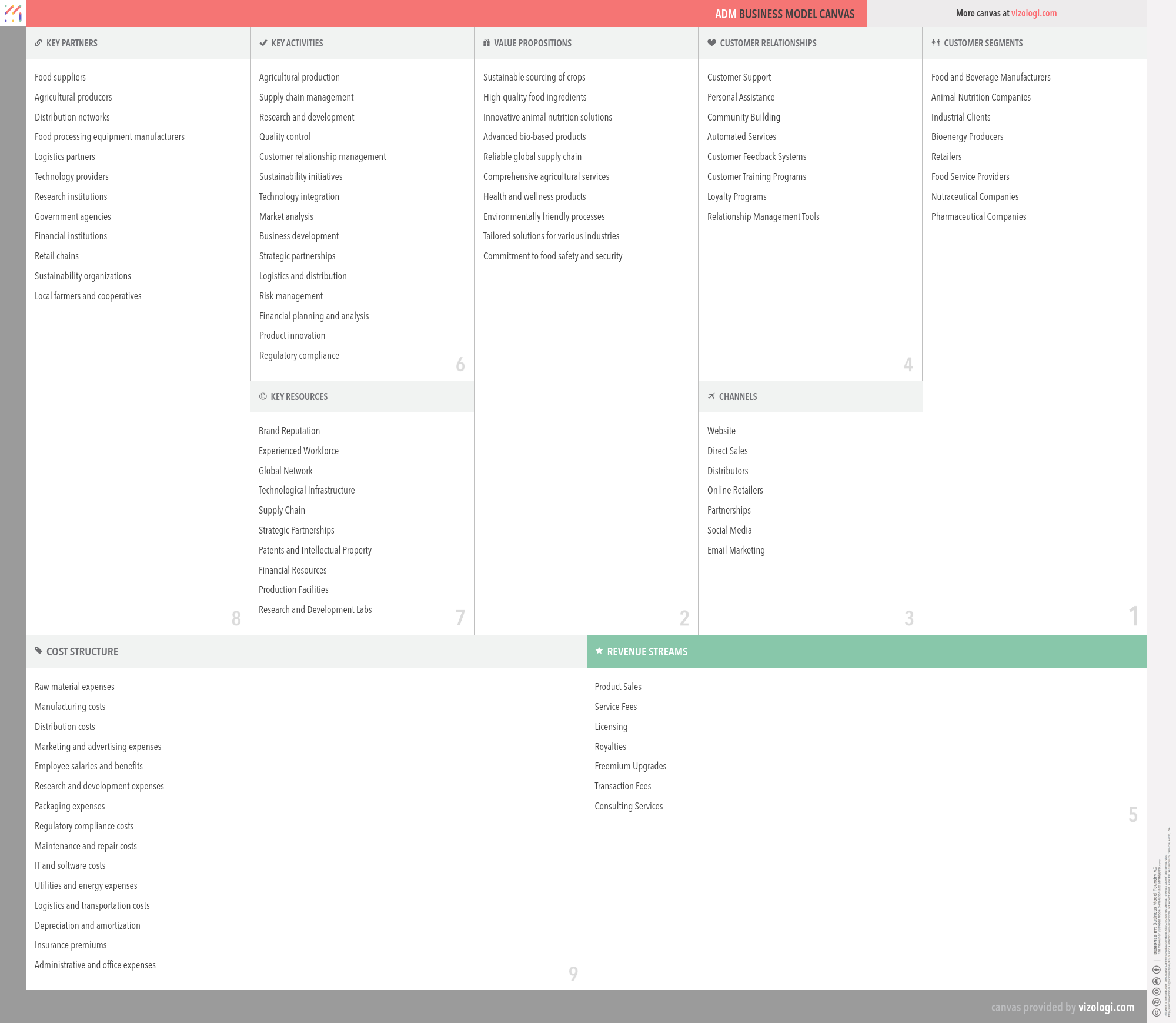
ADMs' business model canvas
Sustainable sourcing of crops, High-quality food ingredients, Innovative animal nutrition solutions, Advanced bio-based products, Reliable g...


Embed code:

- Food suppliers
- Agricultural producers
- Distribution networks
- Food processing equipment manufacturers
- Logistics partners
- Technology providers
- Research institutions
- Government agencies
- Financial institutions
- Retail chains
- Sustainability organizations
- Local farmers and cooperatives
- Agricultural production
- Supply chain management
- Research and development
- Quality control
- Customer relationship management
- Sustainability initiatives
- Technology integration
- Market analysis
- Business development
- Strategic partnerships
- Logistics and distribution
- Risk management
- Financial planning and analysis
- Product innovation
- Regulatory compliance
- Brand Reputation
- Experienced Workforce
- Global Network
- Technological Infrastructure
- Supply Chain
- Strategic Partnerships
- Patents and Intellectual Property
- Financial Resources
- Production Facilities
- Research and Development Labs
- Sustainable sourcing of crops
- High-quality food ingredients
- Innovative animal nutrition solutions
- Advanced bio-based products
- Reliable global supply chain
- Comprehensive agricultural services
- Health and wellness products
- Environmentally friendly processes
- Tailored solutions for various industries
- Commitment to food safety and security
- Customer Support
- Personal Assistance
- Community Building
- Automated Services
- Customer Feedback Systems
- Customer Training Programs
- Loyalty Programs
- Relationship Management Tools
- Food and Beverage Manufacturers
- Animal Nutrition Companies
- Industrial Clients
- Bioenergy Producers
- Retailers
- Food Service Providers
- Nutraceutical Companies
- Pharmaceutical Companies
- Website
- Direct Sales
- Distributors
- Online Retailers
- Partnerships
- Social Media
- Email Marketing
- Raw material expenses
- Manufacturing costs
- Distribution costs
- Marketing and advertising expenses
- Employee salaries and benefits
- Research and development expenses
- Packaging expenses
- Regulatory compliance costs
- Maintenance and repair costs
- IT and software costs
- Utilities and energy expenses
- Logistics and transportation costs
- Depreciation and amortization
- Insurance premiums
- Administrative and office expenses
- Product Sales
- Service Fees
- Licensing
- Royalties
- Freemium Upgrades
- Transaction Fees
- Consulting Services
ADM’s Revenue Model
ADM makes money by combining different business models. Below, you will find the list of the different monetization strategies identified for this company:
ADM makes money by combining different business models. Below, you will find the list of the different monetization strategies identified for this company:
- Agribusiness
- Direct selling
- From push to pull
- Integrator
- Orchestrator
- Solution provider
- Make and distribute
- Dynamic pricing
- Supply chain
- Sustainability-focused
- Energy
- Long tail
- Brands consortium
Analytics
Market Overview
ADM’s Case Study
When we delve into the annals of renowned global corporations transforming the agricultural and food processing industries, Archer Daniels Midland Company (ADM) invariably stands out. Based in Chicago, Illinois, ADM is fam...
ADM's Case Study
When we delve into the annals of renowned global corporations transforming the agricultural and food processing industries, Archer Daniels Midland Company (ADM) invariably stands out. Based in Chicago, Illinois, ADM is famously committed to unlocking the power of nature to enrich lives by addressing global needs for food and renewable energy. But what makes ADM special? Let us explore this by recounting the company’s evolution, remarkable milestones, and key strategies through a storytelling lens intertwined with hard-hitting business case study data.
A Century-Old Legacy
Founded in 1902, ADM has cultivated over a century of expertise in processing agricultural commodities into essential products. With humble beginnings as a linseed crushing company, ADM's journey reflects an unwavering commitment to innovation and sustainability. Today, ADM is one of the largest processors of oilseeds, corn, wheat, and other agricultural commodities globally, offering a kaleidoscope of products from protein meals and vegetable oils to biodiesel and ethanol.
As we unfold the pages of ADM's history, one particular story stands out. It’s 1975, and Agriculture Secretary Earl Butz famously implores the nation to plant "from fencerow to fencerow" to sustain grain prices. ADM answered the call, seizing opportunities in the market volatility and solidifying its position as an industry behemoth. Fast forward to recent times, and ADM’s revenue hit an impressive $64.34 billion in 2022, according to their financial statements (ADM Annual Report, 2022).
Exemplary Vertical Integration
Vertical integration is the backbone of ADM's unique business model. By controlling every stage of the agricultural value chain, from origination to distribution, ADM ensures that the quality and reliability of its products are consistent—a vital facet for its clientele across food, beverage, animal feed, and biofuel sectors.
We recall the revolutionary investment made in 2015 when ADM acquired Wild Flavors for approximately $3 billion, blending ADM's prowess in agricultural origination and processing with Wild Flavors' expertise in natural flavors and ingredients (Bloomberg, 2015). This merger wasn’t merely a business maneuver but a strategic leap into the burgeoning health and wellness market, aligning with emerging consumer preferences for natural and sustainable products.
Operational Network and Global Presence
ADM’s operational effectiveness is bolstered by a geographically dispersed network of facilities. Picture a global landscape dotted with 270 plants and over 420 crop procurement facilities (ADM Website, 2022). This extensive footprint allows ADM to not only streamline its procurement and production processes but also create a robust global supply chain that mitigates risks associated with market fluctuations.
In 2017, ADM’s strategic focus on integrating its facilities and enhancing logistical capabilities took a remarkable turn when they announced the purchase of a stake in the Brazilian soybean processor Algar Agro. This acquisition expanded ADM's origination footprint and fortified its presence in the world’s largest soybean-producing region (Reuters, 2017).
Commitment to Research and Development
Innovation sits at the heart of ADM’s growth strategy, with a significant portion of resources funneled into research and development (R and D). ADM’s R and D expenditure amounted to approximately $114 million in 2021, underscoring its devotion to pioneering new solutions (ADM Annual Report, 2021).
Through innovation centers scattered across the globe, ADM has embarked on collaborative projects that range from advancing plant-based proteins to enhancing biofuel efficiency. For instance, the ADM/Matsutani LLC partnership birthed Fibersol, a premier dietary fiber ingredient renowned for promoting digestive health (NutritionInsight, 2021).
Environmental and Societal Commitment
For ADM, sustainability extends beyond a corporate buzzword; it’s integrated into the company's DNA. The commitment to environmental stewardship is evident in multiple initiatives. In 2020, ADM set an ambitious goal to reduce absolute greenhouse gas (GHG) emissions by 25 percent by 2035 (ADM Sustainability Report, 2020).
Our narrative finds a poignant example in ADM's sustainable practices with the agave-derived ingredient line it introduced in 2019. ADM invested in sustainable agriculture by partnering with local farmers in Mexico, ensuring environmental and community welfare. Dr. Sarah Schmidt, an independent sustainability consultant, echoed the sentiment: "ADM's consistent investment in sustainable practices positions them as a leader in responsible agribusiness" (Schmidt, 2021).
Conclusion: ADM's Multifaceted Strategy
ADM’s strategy amalgamates vertical integration, expansive global operations, relentless innovation, and sustainability. Each facet complements the other, crafting a resilient business model that has weathered more than a century of market ebbs and flows. By leveraging its heritage while continuously innovating, ADM not only meets the intricate needs of its diverse clientele but also sets new benchmarks in sustainability and efficiency.
As we navigate ADM’s story, we are reminded of the words of CEO Juan Luciano, who aptly stated: "Our integrated value chain and global presence create a powerful foundation for growth, making a meaningful impact on pressing global challenges" (Luciano, 2022).
Conclusively, ADM’s enduring success and its compelling blend of tradition, innovation, and sustainability offer invaluable lessons for contemporary enterprises navigating the complex agribusiness landscape.
ADM’s Related Competitors
Compare patterns with Wilmar International, Bunge, COFCO...




+100 Business Book Summaries
We’ve distilled the wisdom of influential business books for you.
Zero to One by Peter Thiel.
The Infinite Game by Simon Sinek.
Blue Ocean Strategy by W. Chan.
…