



Anheuser-Busch InBev’s Company Overview
Anheuser-Busch InBev (AB InBev), headquartered in Leuven, Belgium, is the world's leading brewer with a diverse portfolio of over 500 beer b...
Anheuser-Busch InBev (AB InBev), headquartered in Leuven, Belgium, is the world's leading brewer with a diverse portfolio of over 500 beer brands. Renowned global names such as Budweiser, Corona, and Stella Artois form the cornerstone of its extensive product lineup. The company also boasts prestigious international brands like Beck's, Leffe, and Hoegaarden, complemented by an array of distinguished local brands like Bud Light, Skol, Brahma, Antarctica, Quilmes, Victoria, Modelo Especial, Michelob Ultra, Harbin, Sedrin, Klinskoye, Sibirskaya Korona, Chernigivske, Cass, and Jupiler. In addition to beer, AB InBev sustains a robust foothold in the non-alcoholic beverages sector through strategic partnerships, such as with PepsiCo, enhancing its market presence and consumer offerings.
AB InBev operates on a vertically integrated business model that encapsulates the entire lifecycle of its products—from brewing and bottling to distribution and marketing. This end-to-end control allows the company to maintain stringent quality standards and maximize efficiency across its global supply chain. Distinguishing itself through innovation and sustainability, AB InBev employs advanced brewing techniques and adheres to eco-friendly practices to minimize environmental impact. The company emphasizes community engagement and corporate responsibility, investing significantly in local initiatives and championing causes such as water conservation and responsible consumption.
The revenue model of AB InBev is multifaceted, designed to generate substantial and stable income through various streams. Primarily, revenue is derived from the sale of its extensive array of alcoholic and non-alcoholic beverages globally. The company's diversified portfolio enables it to tap into different market segments, from premium to value brands. Additionally, AB InBev secures income through its subsidiary Ambev, which functions as a PepsiCo bottler under bottling and distribution agreements, facilitating the distribution of brands like Pepsi, 7UP, and Gatorade. By leveraging these varied revenue streams, AB InBev ensures a robust and resilient financial performance, continuously driving growth and shareholder value.
Headquater: Leuven, Belgium, EU
-
Foundations date: 2008
-
Company Type: Subsidiary
-
Sector: Consumer Goods
-
Category: Food & Beverages
-
Digital Maturity: Conservative
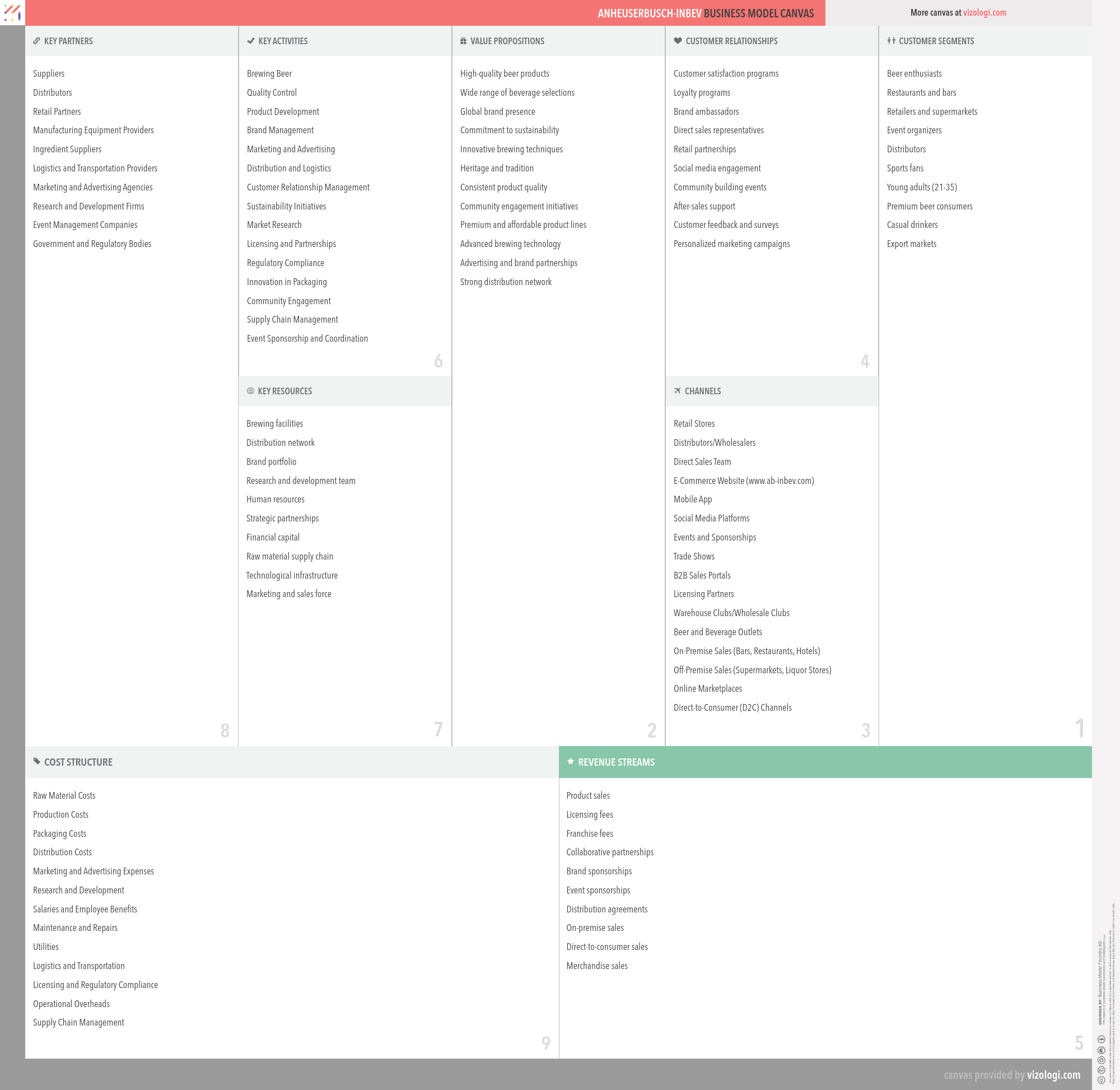
Anheuser-Busch InBevs' business model canvas
High-quality beer products, Wide range of beverage selections, Global brand presence, Commitment to sustainability, Innovative brewing techn...


Embed code:

- Suppliers
- Distributors
- Retail Partners
- Manufacturing Equipment Providers
- Ingredient Suppliers
- Logistics and Transportation Providers
- Marketing and Advertising Agencies
- Research and Development Firms
- Event Management Companies
- Government and Regulatory Bodies
- Brewing Beer
- Quality Control
- Product Development
- Brand Management
- Marketing and Advertising
- Distribution and Logistics
- Customer Relationship Management
- Sustainability Initiatives
- Market Research
- Licensing and Partnerships
- Regulatory Compliance
- Innovation in Packaging
- Community Engagement
- Supply Chain Management
- Event Sponsorship and Coordination
- Brewing facilities
- Distribution network
- Brand portfolio
- Research and development team
- Human resources
- Strategic partnerships
- Financial capital
- Raw material supply chain
- Technological infrastructure
- Marketing and sales force
- High-quality beer products
- Wide range of beverage selections
- Global brand presence
- Commitment to sustainability
- Innovative brewing techniques
- Heritage and tradition
- Consistent product quality
- Community engagement initiatives
- Premium and affordable product lines
- Advanced brewing technology
- Advertising and brand partnerships
- Strong distribution network
- Customer satisfaction programs
- Loyalty programs
- Brand ambassadors
- Direct sales representatives
- Retail partnerships
- Social media engagement
- Community building events
- After-sales support
- Customer feedback and surveys
- Personalized marketing campaigns
- Beer enthusiasts
- Restaurants and bars
- Retailers and supermarkets
- Event organizers
- Distributors
- Sports fans
- Young adults (21-35)
- Premium beer consumers
- Casual drinkers
- Export markets
- Retail Stores
- Distributors/Wholesalers
- Direct Sales Team
- E-Commerce Website (www.ab-inbev.com)
- Mobile App
- Social Media Platforms
- Events and Sponsorships
- Trade Shows
- B2B Sales Portals
- Licensing Partners
- Warehouse Clubs/Wholesale Clubs
- Beer and Beverage Outlets
- On-Premise Sales (Bars, Restaurants, Hotels)
- Off-Premise Sales (Supermarkets, Liquor Stores)
- Online Marketplaces
- Direct-to-Consumer (D2C) Channels
- Raw Material Costs
- Production Costs
- Packaging Costs
- Distribution Costs
- Marketing and Advertising Expenses
- Research and Development
- Salaries and Employee Benefits
- Maintenance and Repairs
- Utilities
- Logistics and Transportation
- Licensing and Regulatory Compliance
- Operational Overheads
- Supply Chain Management
- Product sales
- Licensing fees
- Franchise fees
- Collaborative partnerships
- Brand sponsorships
- Event sponsorships
- Distribution agreements
- On-premise sales
- Direct-to-consumer sales
- Merchandise sales
Anheuser-Busch InBev’s Revenue Model
Anheuser-Busch InBev makes money by combining different business models. Below, you will find the list of the different monetization strategies identified for this company:
Anheuser-Busch InBev makes money by combining different business models. Below, you will find the list of the different monetization strategies identified for this company:
- Low touch
- Customer loyalty
- Long tail
- Make and distribute
- Dynamic branding
- Culture is brand
- Acquiring non customers
- Brands consortium
- Bundling
- Cross-subsidiary
- Customer relationship
- Experience selling
- Ingredient branding
- Regular replacement
- Sponsorship
Analytics
Market Overview
Anheuser-Busch InBev’s Case Study
Elegantly nestled in the picturesque town of Leuven, Belgium, Anheuser-Busch InBev (AB InBev) masters the art of brewing with a breadth that spans over 500 beer brands. Our company, the world's leading bre...
Anheuser-Busch InBev's Case Study
Elegantly nestled in the picturesque town of Leuven, Belgium, Anheuser-Busch InBev (AB InBev) masters the art of brewing with a breadth that spans over 500 beer brands. Our company, the world's leading brewer, stands not only as a beacon of quality and innovation but also as an emblem of profound market influence and unparalleled heritage. This case study unravels the strategies, practices, and actions that make AB InBev a cornerstone in the global beverage industry.
A Blend of Heritage and Modernity
AB InBev's story is entwined with a rich historical legacy, dating back to 2008 when it emerged as a juggernaut through the merger of the American company Anheuser-Busch and the Belgian-Brazilian AmBev. This powerful integration facilitated a synergetic expansion, marrying traditional European brewing techniques with innovative business practices conducive to the dynamic consumer needs of modern times.
Guided by an unwavering commitment to quality, AB InBev operates a vertically integrated business model. From the artisanal brewing of renowned brands like Budweiser, Corona, and Stella Artois, to the meticulous bottling and eventual distribution, every step encapsulates a rigorous quality control standard. According to a 2022 report by Beverage Daily, AB InBev holds a commanding 26 percent market share in the global beer market, a testament to its robust operational blueprint (Beverage Daily, 2022).
Innovation as the Beacon
Our profitable voyage is steered by a dedication to innovation. AB InBev has been at the frontier of pioneering advanced brewing techniques and sustainable practices. Sustainability, for instance, emerges as a pivotal pillar in AB InBev's strategy. The company's 2025 Sustainability Goals aim to ensure that 100 percent of its products are in returnable or recycled packaging (AB InBev, 2021).
Consider the Zythos project, developed in collaboration with leading research firms. This project harnesses state-of-the-art fermentation techniques to create brews with reduced environmental footprints. Additionally, AB InBev's groundbreaking efforts in water conservation have saved over 1.9 billion liters of water annually since 2017 (AB InBev, 2021).
Empowering the Local and Acquiring the Global
AB InBev’s strategy magnifies its dual focus on local relevance and global dominance. By nurturing local brands like Brahma in Brazil, Cass in South Korea, and Harbin in China, we seamlessly blend into the cultural fabrics of diverse markets. As noted by industry expert Michael Porter, "organizations embed themselves deeply within regional cultures while leveraging global scale"—a philosophy AB InBev has truly perfected.
In the global landscape, AB InBev's strategic acquisitions and partnerships amplify its reach. The 2016 acquisition of SABMiller for $107 billion stands as a landmark triumph, positioning AB InBev as a veritable titan in the beverage domain (Financial Times, 2016).
Navigating the Digital Terrain
Despite a reputation for being conservative in digital adoption, we have steadily carved a niche in the digital ecosystem. By launching a comprehensive e-commerce platform and leveraging social media engagements, AB InBev meets consumers where they are—online. Our commitment to digital transformation saw a 20 percent surge in e-commerce revenue in 2021, positioning us adroitly for future growth (AB InBev, 2021).
An additional remarkable venture is Beer Garage, our global innovation center headquartered in Silicon Valley. This hub accelerates digital innovations ranging from AI-powered analytics to predictive quality control systems, showcasing our commitment to staying at the digital forefront.
Community-Centric and Responsibly Driven
AB InBev's distinctions are not measurable only in financial metrics but also in its substantial societal contributions. The company's proactive societal engagement and corporate responsibility are noteworthy. In alignment with our sustainability goals, investing in community-focused water conservation projects and championing responsible consumption are initiatives that resonate with our overarching commitment to societal well-being.
A case in point is our partnership with Water.org, which has provided access to safe water to over 3.5 million people in water-scarce regions (Water.org, 2021). By integrating such initiatives into our operational ethos, we construct a brand narrative that transcends mere profit-making.
Financial Robustness and Diverse Revenue Streams
AB InBev's financial dexterity is manifest in its diverse revenue streams. Including sales of our rich portfolio of alcoholic and non-alcoholic beverages, strategic partnerships like our longstanding collaboration with PepsiCo broaden and stabilize our income channels. In 2021, our strategic alliances and robust distribution networks cushioned us against market volatility, affirming our resilient financial health.
In essence, AB InBev’s capability to balance premium and value brands empowers it to effectively navigate diverse market segments. With the subsidiary Ambev acting as a pivotal distributor under PepsiCo agreements, brands such as Pepsi, 7UP, and Gatorade seamlessly weave into our portfolio, amplifying revenues while enriching our brand ecosystem.
A Future Brimming with Potential
Analyzing AB InBev’s business framework reveals a narrative of relentless pursuit—of quality, sustainability, and innovation. As we venture forward, our roadmap is clear: augment digital integration, deepen local engagement, and heighten our sustainability-driven initiatives. AB InBev's journey, embellished with historical prestige and forward-thinking strategies, exemplifies a harmonious blend of tradition and innovation. Our tale is one of success, community, and an unyielding commitment to brewing excellence.
From Leuven to every corner of the globe, we at AB InBev toast to a future where heritage harmonizes with innovation, and every sip celebrates our enduring legacy. Cheers to that!
--- References AB InBev. (2021). 2025 Sustainability Goals Report. Beverage Daily. (2022). Global Beer Market Share Analysis. Financial Times. (2016). Anheuser-Busch InBev and SABMiller Merger. Water.org. (2021). Partner Impact Report.
Anheuser-Busch InBev’s Related Competitors
Compare patterns with Heineken Holding, Danone, Brewdog...



+100 Business Book Summaries
We’ve distilled the wisdom of influential business books for you.
Zero to One by Peter Thiel.
The Infinite Game by Simon Sinek.
Blue Ocean Strategy by W. Chan.
…