



Bayer’s Company Overview
Bayer AG, headquartered in Leverkusen, North Rhine-Westphalia, Germany, is a global leader in the fields of healthcare and agriculture, with...
Bayer AG, headquartered in Leverkusen, North Rhine-Westphalia, Germany, is a global leader in the fields of healthcare and agriculture, with a rich legacy dating back to its founding in 1863. The conglomerate's diverse portfolio spans human and veterinary pharmaceuticals, consumer healthcare products, agricultural chemicals, and biotechnology innovations. Bayer's commitment to advancing health and nutrition is evident through its continuous drive for innovation, spanning across sectors to improve people's lives and support global agricultural demands. Bayer is part of the Euro Stoxx 50 stock market index, reflecting its significant economic influence and industry leadership.
Bayer’s business model is unique in its holistic approach to the markets it serves. In healthcare, Bayer combines pharmaceutical and over-the-counter products to address comprehensive health needs. Its pharmaceutical division prioritizes research and development, focusing on areas such as oncology, cardiology, and women's health. In the agricultural sector, Bayer merges chemical crop protection and advanced biotechnology to offer integrated solutions for sustainable farming practices. This synthesis of healthcare and agriculture drives Bayer's innovative edge, ensuring that it can provide multi-faceted solutions that meet current and future challenges, whether in health or food security.
The revenue model of Bayer is multifaceted, leveraging its expansive product range and global presence. In the healthcare segment, Bayer generates significant income through the sales of prescription medications, over-the-counter products, and diagnostic services. The agricultural division contributes substantial revenue via the sale of crop protection products, seeds, and digital farming solutions designed to optimize agricultural productivity. Additionally, Bayer invests in partnerships and collaborations to drive mutual growth and expand its technological capabilities. This diversified revenue stream strategy ensures Bayer's financial stability and supports its ongoing investments in research and development, aimed at driving long-term innovation and market leadership.
Headquater: Leverkusen, Germany, EU
-
Foundations date: 1863
-
Company Type: Public
-
Sector: Healthcare
-
Category: Pharmaceuticals
-
Digital Maturity: Digirati
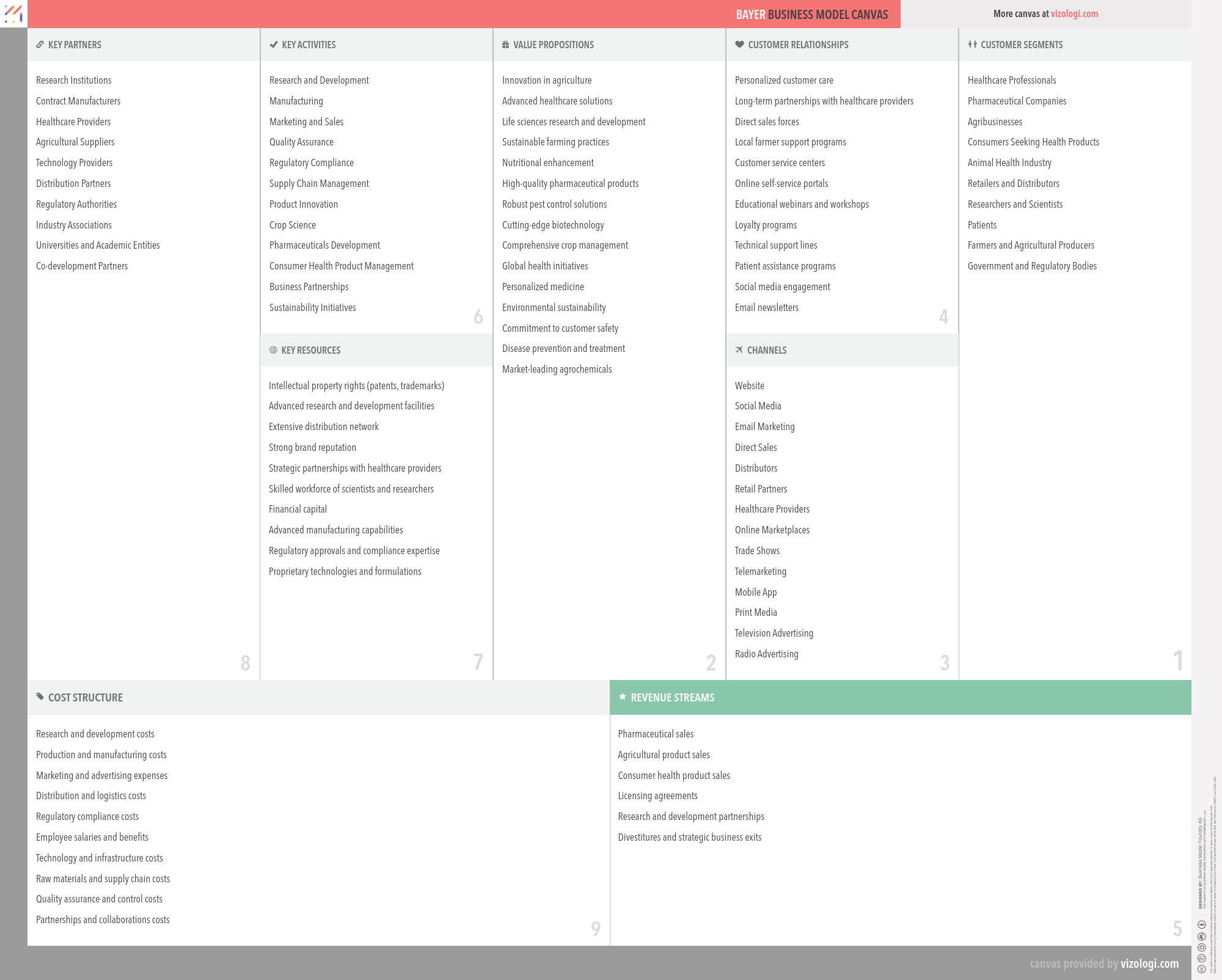
Bayers' business model canvas
Innovation in agriculture, Advanced healthcare solutions, Life sciences research and development, Sustainable farming practices, Nutritional...


Embed code:

- Research Institutions
- Contract Manufacturers
- Healthcare Providers
- Agricultural Suppliers
- Technology Providers
- Distribution Partners
- Regulatory Authorities
- Industry Associations
- Universities and Academic Entities
- Co-development Partners
- Research and Development
- Manufacturing
- Marketing and Sales
- Quality Assurance
- Regulatory Compliance
- Supply Chain Management
- Product Innovation
- Crop Science
- Pharmaceuticals Development
- Consumer Health Product Management
- Business Partnerships
- Sustainability Initiatives
- Intellectual property rights (patents, trademarks)
- Advanced research and development facilities
- Extensive distribution network
- Strong brand reputation
- Strategic partnerships with healthcare providers
- Skilled workforce of scientists and researchers
- Financial capital
- Advanced manufacturing capabilities
- Regulatory approvals and compliance expertise
- Proprietary technologies and formulations
- Innovation in agriculture
- Advanced healthcare solutions
- Life sciences research and development
- Sustainable farming practices
- Nutritional enhancement
- High-quality pharmaceutical products
- Robust pest control solutions
- Cutting-edge biotechnology
- Comprehensive crop management
- Global health initiatives
- Personalized medicine
- Environmental sustainability
- Commitment to customer safety
- Disease prevention and treatment
- Market-leading agrochemicals
- Personalized customer care
- Long-term partnerships with healthcare providers
- Direct sales forces
- Local farmer support programs
- Customer service centers
- Online self-service portals
- Educational webinars and workshops
- Loyalty programs
- Technical support lines
- Patient assistance programs
- Social media engagement
- Email newsletters
- Healthcare Professionals
- Pharmaceutical Companies
- Agribusinesses
- Consumers Seeking Health Products
- Animal Health Industry
- Retailers and Distributors
- Researchers and Scientists
- Patients
- Farmers and Agricultural Producers
- Government and Regulatory Bodies
- Website
- Social Media
- Email Marketing
- Direct Sales
- Distributors
- Retail Partners
- Healthcare Providers
- Online Marketplaces
- Trade Shows
- Telemarketing
- Mobile App
- Print Media
- Television Advertising
- Radio Advertising
- Research and development costs
- Production and manufacturing costs
- Marketing and advertising expenses
- Distribution and logistics costs
- Regulatory compliance costs
- Employee salaries and benefits
- Technology and infrastructure costs
- Raw materials and supply chain costs
- Quality assurance and control costs
- Partnerships and collaborations costs
- Pharmaceutical sales
- Agricultural product sales
- Consumer health product sales
- Licensing agreements
- Research and development partnerships
- Divestitures and strategic business exits
Bayer’s Revenue Model
Bayer makes money by combining different business models. Below, you will find the list of the different monetization strategies identified for this company:
Bayer makes money by combining different business models. Below, you will find the list of the different monetization strategies identified for this company:
- Cross-subsidiary
- Archetypes of business model design
- Decomposition
- Sponsorship
- Brands consortium
- Customer loyalty
- Customer data
- Lock-in
- Supply chain
- Skunkworks project
- Biopharma
- Corporate innovation
- Technology trends
- Combining data within and across industries
- Low touch
- Open innovation
- Collaborative production
- Crowdsourcing
- Healthcare
- Licensing
- Make and distribute
- Digital transformation
- Agribusiness
- Orchestrator
Analytics
Market Overview
Bayer’s Case Study
: A Testament to Innovation and Integration When we think of Bayer, a name that resonates with both healthcare and agriculture, it’s impossible not to appreciate the magnitude of its influence. Established in 1863, Baye...
Bayer's CASE STUDY: A Testament to Innovation and Integration
When we think of Bayer, a name that resonates with both healthcare and agriculture, it’s impossible not to appreciate the magnitude of its influence. Established in 1863, Bayer has consistently positioned itself as a vanguard for innovation and sustainability in its respective fields. The company, headquartered in Leverkusen, Germany, has evolved from a simple dyestuffs factory into a conglomerate that addresses some of the world's most pressing challenges in health and nutrition.
Innovation at the Core
Bayer's success is deeply rooted in its commitment to innovation. From the development of life-changing pharmaceuticals to pioneering advancements in agriculture, Bayer’s business model is unique in its holistic approach to the markets it serves. Unlike many companies that operate in isolated sectors, Bayer has seamlessly integrated its capabilities to foster a synthesis of healthcare and agricultural solutions. This approach is essential in understanding Bayer's exemplary performance and its ability to remain a market leader.
In healthcare, Bayer’s emphasis on research and development (R&D) ensures that they remain at the forefront of medical innovation. With significant investments in oncology, cardiology, and women’s health, they've produced transformative solutions that address critical health needs. Their introduction of Xarelto, an oral anticoagulant, is a testament to their commitment to life-saving innovations. According to Bayer’s 2022 Annual Report, their pharmaceutical segment alone generated €19.3 billion, which underscores the impact of their R&D investments (Bayer, 2022).
Agricultural Ingenuity
The agricultural division of Bayer is a paramount example of how multidisciplinary integration can yield sustainable solutions. By combining chemical crop protection with advanced biotechnology, Bayer provides comprehensive solutions that enhance agricultural productivity and sustainability. One of their standout products, DEKALB seed, has optimized crop yields for farmers globally. Their digital farming solutions, like the Climate FieldView platform, further exemplify Bayer’s prowess in leveraging technology for agriculture.
In 2021, the Crop Science division reported revenues of €20.2 billion, reflecting the substantial market demand for their innovative products and solutions (Bayer, 2021). With a commitment to environmental stewardship, Bayer has continually developed products that support sustainable farming practices, ensuring that they contribute positively to the global fight against climate change.
The Revenue Model: A Multitude of Streams
Bayer’s diversification in its revenue streams is a key strategy in its financial health and resilience. The healthcare segment leverages the sale of both prescription medications and over-the-counter products, contributing significantly to their revenue. Their consumer health products, including well-known brands like Aspirin and Claritin, complement their pharmaceutical offerings, creating a comprehensive healthcare portfolio.
In agriculture, Bayer’s revenue is driven by their extensive range of crop protection products, seeds, and digital solutions. The company's strategic acquisitions, such as the $63 billion acquisition of Monsanto in 2018, have fortified their market position and expanded their technological capabilities (Reuters, 2018). This acquisition was a bold move that redefined Bayer’s role in agribusiness, combining expertise across two giants for unprecedented market influence.
Commitment to Sustainability
Sustainability lies at the heart of Bayer’s operations, resonating through their comprehensive R&D efforts and product portfolios. By 2030, Bayer aims to achieve carbon neutrality within their own operations, a pledge that underscores their dedication to sustainability (Bayer, 2022). Their efforts in promoting sustainable farming through crop innovation and advocating for climate-smart agricultural practices demonstrate a commitment that goes beyond profit, aiming for long-term ecological balance and food security.
Customer-Centric Approach
From personalized customer care to local farmer support programs, Bayer’s approach to customer relationships is multifaceted. They leverage a blend of direct sales forces, online self-service portals, and educational webinars to educate and support their diverse customer base. Bayer’s consumer-centric paradigm extends to their patient assistance programs, ensuring that essential medications are accessible to those in need. This aligns with their broader mission of reducing healthcare disparities and fostering wellness on a global scale.
According to Professor Michael Porter from Harvard Business School, “A company’s competitive strategy must hinge on the creation of a unique and valuable position involving a different set of activities.” Bayer exemplifies this through their integration of healthcare and agriculture, distinctively positioning themselves as a pioneer in addressing multidimensional issues.
The Future of Bayer
As Bayer marches into the future, the company’s commitment to innovation, sustainability, and holistic problem-solving remains clear. With their eyes set on transformative R&D, robust product portfolios, and sustainable practices, Bayer is well-poised to continue making significant strides in healthcare and agriculture. By blending these arenas, they not only carve out a unique market position but also contribute meaningfully to global health and food security challenges.
In an era where the interplay between industries can determine success, Bayer serves as an illustrative case study of how strategic integration across sectors can drive both innovation and growth. Through a customer-centered approach and unwavering dedication to sustainability, Bayer not only meets contemporary demands but also pioneers solutions for the future.
Bayer’s journey is a testament to the power of innovation and integration in driving industry leadership and societal impact, setting a gold standard for companies striving to make a difference in the world.
---
This case study underscores the significance of Bayer’s integrated strategy and commitment to innovation. As we reflect on Bayer’s remarkable journey, it is evident that their strategic foresight and diversified approach have been pivotal in cementing their status as a global leader in both healthcare and agriculture.
References: Bayer AG. (2022). Annual Report 2021. Retrieved from www.bayer.com Reuters. (2018). Bayer Closes $63 Billion Monsanto Deal, Plans Delisting. Retrieved from www.reuters.com
Bayer’s Related Competitors
Compare patterns with Roche Group, Novartis, Cardinal Health...




+100 Business Book Summaries
We’ve distilled the wisdom of influential business books for you.
Zero to One by Peter Thiel.
The Infinite Game by Simon Sinek.
Blue Ocean Strategy by W. Chan.
…