



Benevity’s Company Overview
Benevity, Inc. is a global leader in online corporate social responsibility and employee engagement software. The Calgary-based company prov...
Benevity, Inc. is a global leader in online corporate social responsibility and employee engagement software. The Calgary-based company provides an innovative platform that helps businesses around the world engage their employees and customers in charitable giving and volunteering. Founded in 2008, Benevity has grown into a trusted partner for hundreds of Fortune 1000 companies, helping them to foster a culture of goodness and positively impact their communities. The company's software solutions include Benevity Causes, a portal for nonprofits to access and manage corporate giving and volunteering opportunities, and Benevity Workplace, a comprehensive platform for corporations to manage and track their employees' charitable activities.
Benevity's business model revolves around providing software as a service (SaaS) to corporations. The company offers its clients a comprehensive suite of tools to manage and streamline their corporate philanthropy and social responsibility programs. This includes everything from facilitating employee giving and volunteering to tracking and reporting on the impacts of these initiatives. Benevity's platform enables companies to engage their employees in meaningful ways, fostering a culture of corporate social responsibility and positively impacting their brand reputation.
As for its revenue model, Benevity primarily generates income through subscription fees for its software services. Companies pay a recurring fee to use Benevity's platform, which varies depending on the size of the company and the specific services they utilize. Additionally, Benevity charges a small transaction fee for the funds processed through its platform. This dual revenue stream allows Benevity to maintain and continuously improve its platform, while also providing a scalable solution for businesses of all sizes to manage their corporate philanthropy programs.
Headquater: Calgary, Alberta, Canada
-
Foundations date: 2008
-
Company Type: Social enterprise
-
Sector: Technology
-
Category: Software
-
Digital Maturity: Digirati
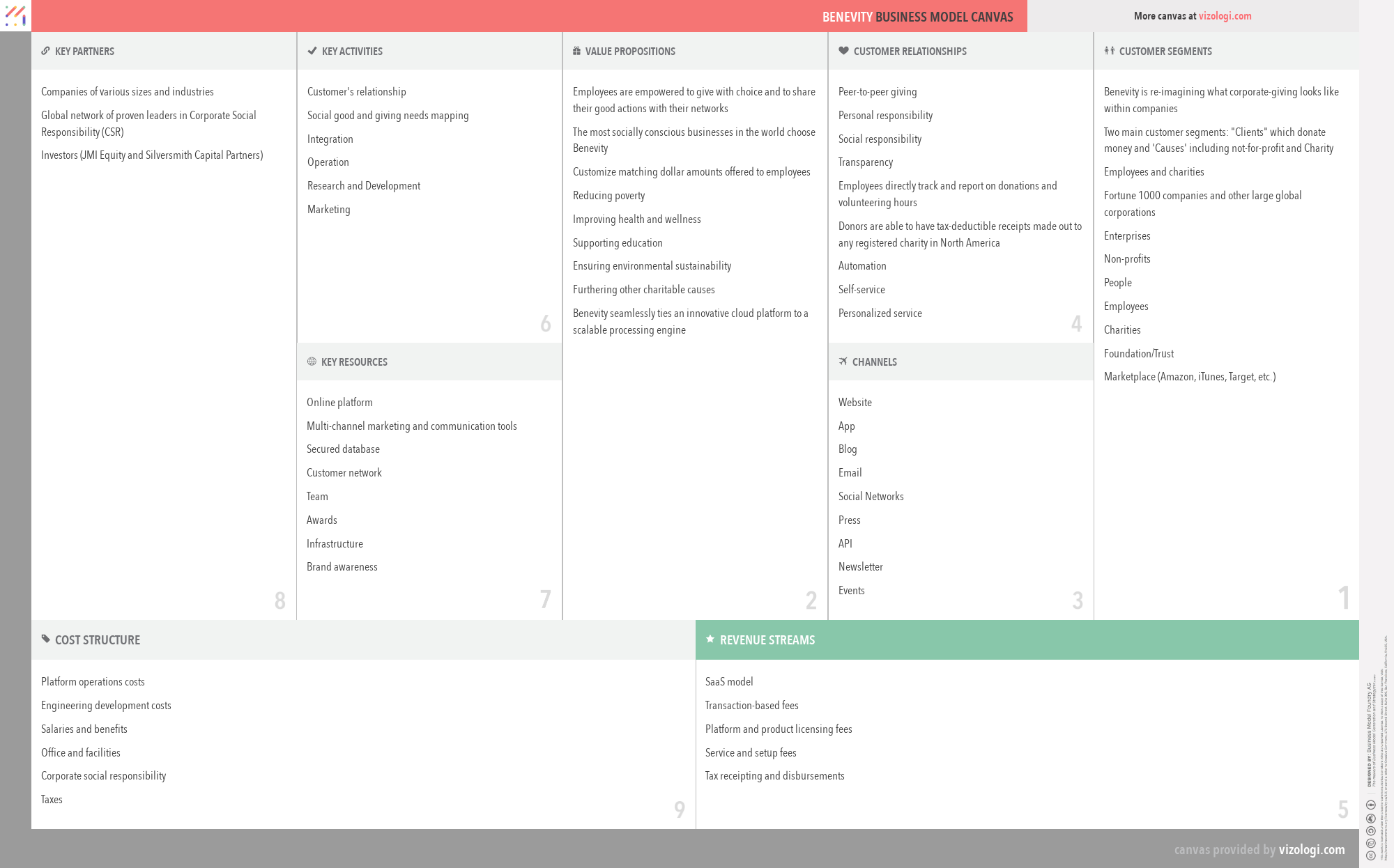
Benevitys' business model canvas
Employees are empowered to give with choice and to share their good actions with their networks, The most socially conscious businesses in t...


Embed code:

- Companies of various sizes and industries
- Global network of proven leaders in Corporate Social Responsibility (CSR)
- Investors (JMI Equity and Silversmith Capital Partners)
- Customer's relationship
- Social good and giving needs mapping
- Integration
- Operation
- Research and Development
- Marketing
- Online platform
- Multi-channel marketing and communication tools
- Secured database
- Customer network
- Team
- Awards
- Infrastructure
- Brand awareness
- Employees are empowered to give with choice and to share their good actions with their networks
- The most socially conscious businesses in the world choose Benevity
- Customize matching dollar amounts offered to employees
- Reducing poverty
- Improving health and wellness
- Supporting education
- Ensuring environmental sustainability
- Furthering other charitable causes
- Benevity seamlessly ties an innovative cloud platform to a scalable processing engine
- Peer-to-peer giving
- Personal responsibility
- Social responsibility
- Transparency
- Employees directly track and report on donations and volunteering hours
- Donors are able to have tax-deductible receipts made out to any registered charity in North America
- Automation
- Self-service
- Personalized service
- Benevity is re-imagining what corporate-giving looks like within companies
- Two main customer segments: "Clients" which donate money and 'Causes' including not-for-profit and Charity
- Employees and charities
- Fortune 1000 companies and other large global corporations
- Enterprises
- Non-profits
- People
- Employees
- Charities
- Foundation/Trust
- Marketplace (Amazon, iTunes, Target, etc.)
- Website
- App
- Blog
- Social Networks
- Press
- API
- Newsletter
- Events
- Platform operations costs
- Engineering development costs
- Salaries and benefits
- Office and facilities
- Corporate social responsibility
- Taxes
- SaaS model
- Transaction-based fees
- Platform and product licensing fees
- Service and setup fees
- Tax receipting and disbursements
Benevity’s Revenue Model
Benevity makes money by combining different business models. Below, you will find the list of the different monetization strategies identified for this company:
Benevity makes money by combining different business models. Below, you will find the list of the different monetization strategies identified for this company:
- Software as a Service (SaaS)
- Transaction facilitator
- Corporate innovation
- Crowdfunding
- Crowdsourcing
- Customer loyalty
- Customer relationship
- Digital transformation
- Donation-based
- Ecosystem
- Experience
- Freemium
- Market research
- Online marketplace
- Open innovation
- Social stakeholder
- Sustainability-focused
- Technology trends
- Two-sided market
Analytics
Market Overview
Benevity’s Case Study
When we dive into the realm of corporate social responsibility, one name stands out as a paragon of innovation and impact—Benevity. This Calgary-based company has revolutionized how businesses engage in charitable g...
Benevity's CASE STUDY
When we dive into the realm of corporate social responsibility, one name stands out as a paragon of innovation and impact—Benevity. This Calgary-based company has revolutionized how businesses engage in charitable giving and employee volunteering, making a difference not just for corporate clients but for communities globally. In this case study, we'll take a close look at what makes Benevity extraordinary by exploring its journey, business model, key activities, and unique value propositions.
The Genesis of Benevity
In 2008, Benevity emerged from Calgary, Alberta, with a singular vision: to make it easy for companies to do good. Founded by Bryan de Lottinville, Benevity aimed to fill a gap in corporate social responsibility by leveraging technology to streamline philanthropic activities. Over a decade later, the company has become a trusted partner for hundreds of Fortune 1000 companies, boasting clients such as Google, Microsoft, and Apple.
Our story begins with an insight into the pain points businesses experience. Many corporations struggle with the administrative burden of managing charitable activities, including tracking donations, organizing volunteer events, and reporting impact. Benevity's Software as a Service (SaaS) model addresses these issues by offering a comprehensive platform that simplifies and automates these tasks.
Innovative Business Model
Benevity's business model revolves primarily around a SaaS framework. This enables corporations to subscribe to a suite of tools designed to facilitate their social responsibility programs. What sets Benevity apart is its dual-revenue stream: subscription fees and transaction-based charges. According to a 2022 report from SaaS Capital, dual-revenue models offer greater financial stability and durability, a strategy that has paid dividends for Benevity.
The company's revenue through subscriptions varies based on the size of the client and the extent of services used. Moreover, they levy a modest transaction fee for funds processed through their platform. This pricing model not only keeps the company profitable but also incentivizes them to continuously enhance and scale their offerings.
Key Activities and Resources
The value and uniqueness of Benevity lie in a meticulous blend of its key activities and resources. The cornerstone of Benevity's operations is its robust online platform. It integrates various functionalities—employee giving, volunteer tracking, and comprehensive reporting. Supported by a secure database and multi-channel communication tools, the platform serves as a one-stop shop for corporate social responsibility.
To keep the engine running, Benevity invests heavily in research and development. Initiatives such as user experience studies and technology trend analysis help them stay ahead of the curve. As a result, they can rapidly adapt to new client needs and technological advancements.
Unique Value Propositions
Benevity offers a plethora of value propositions that make it an indispensable tool for corporations. One of the key points is empowering employees to make choices in their giving. They have the autonomy to select the causes they care about most, thereby fostering a culture of personal responsibility and engagement. This freedom not only increases employee satisfaction but also boosts participation rates. According to a 2021 PwC study, companies with high employee engagement outperform their competitors by 147%.
But Benevity does more than just empower employees; it also customizes matching dollar amounts offered by corporations. This flexibility ensures that charitable contributions are amplified, magnifying the overall impact. Additionally, employees can track and share their contributions, enabling a transparent and accountable system.
Customer Relationships and Segments
At its core, Benevity is about building meaningful relationships. Their platform supports peer-to-peer giving, where employees can encourage their peers to participate. This fosters a sense of community and collective responsibility. The automation features, such as instant tax receipts and direct reporting, ensure a seamless experience for both donors and administrators.
Benevity serves two primary customer segments: corporate clients (or "donors") and nonprofit organizations (referred to as "causes"). These segments include Fortune 1000 companies, other large global corporations, non-profits, and charities. Their marketplace channel collaborates with major retailers like Amazon and Target, increasing both visibility and impact.
Impact and Outcomes
Benevity’s impact goes beyond numbers, touching lives and communities worldwide. Their clients have reported a significant uptick in employee engagement metrics. For instance, Microsoft saw a 22% increase in volunteer hours in 2020 after integrating Benevity’s platform. Furthermore, according to Benevity’s 2022 report, the platform facilitated over $7 billion in charitable donations globally.
Through partnerships and collaborations, Benevity also contributes to environmental sustainability, health and wellness, education, and poverty reduction. By seamlessly tying an innovative cloud platform to a scalable processing engine, Benevity has made it easier for companies to take a step towards a better world—one donation and volunteer hour at a time.
Expert Insights
Pioneers and experts in corporate social responsibility consistently highlight Benevity's unique and effective approach. According to Michael Porter of Harvard Business School, "Strategy is about making choices, trade-offs; it's about deliberately choosing to be different." Benevity epitomizes this by offering unique features that set them apart from traditional CSR platforms.
Similarly, Emily Caruso, a leading analyst of CSR trends at Forrester, asserts, "Companies today need more than just philanthropic strategies; they need platforms that integrate into their existing corporate culture seamlessly." Benevity, with its advanced integrative capabilities, fulfills this need, making it a preferred choice for many top-tier companies.
Conclusion
Benevity’s case is a shining example of how innovation and technology can significantly enhance corporate social responsibility. With a robust business model, key activities concentrated on continuous improvement, and unique value propositions, Benevity has not only carved a niche for itself but also set new standards for CSR frameworks globally. As we look to the future, Benevity's commitment to making the world a better place exemplifies what true corporate responsibility looks like in the digital age.
Benevity’s Related Competitors
Compare patterns with Darwinbox, Microsoft, Mozilla Foundation...




+100 Business Book Summaries
We’ve distilled the wisdom of influential business books for you.
Zero to One by Peter Thiel.
The Infinite Game by Simon Sinek.
Blue Ocean Strategy by W. Chan.
…