



DraftKings’s Company Overview
DraftKings, Inc. is a pioneer in the world of digital sports entertainment, dedicated to transforming fans' engagement with their favorite s...
DraftKings, Inc. is a pioneer in the world of digital sports entertainment, dedicated to transforming fans' engagement with their favorite sports. Initially renowned for its daily and weekly fantasy sports contests, DraftKings has now diversified its offerings to include sports betting, iGaming, and a media platform, catering to a wide audience of sports enthusiasts across the United States and Canada. The company's mission is to fuel the competition and excitement of sports fandom through innovative products and services that bring fans closer to the games they love. From fantasy leagues for football, baseball, basketball, hockey, golf, and various collegiate sports to a comprehensive sportsbook and casino games, DraftKings is at the forefront of interactive and immersive sports entertainment.
DraftKings employs a multi-faceted business model that sets it apart in the industry. The company leverages advanced technology and data analytics to deliver a premium user experience across its suite of products. Through its fantasy sports contests, users can draft teams of professional athletes and compete based on the statistical performance of those athletes in real games, offering a compelling and engaging way to participate in sports. Additionally, the sports betting platform allows users to place bets on a wide range of sporting events, providing real-time updates and opportunities for in-play betting. The iGaming segment encompasses an array of online casino games, broadening the scope of DraftKings' entertainment value proposition. By integrating these services into a cohesive ecosystem, DraftKings offers a seamless and dynamic platform for sports fans and gaming enthusiasts alike.
The revenue model of DraftKings is diverse and robust, ensuring sustained growth and profitability. Revenue is generated through several key streams, including entry fees for fantasy sports contests, from which the company takes a percentage as commission. In the sports betting domain, DraftKings earns money via the "vigorish" or "vig," which is the difference between the bet placed by users and the payout distributed. The iGaming sector contributes to revenue through wagers placed on casino games, with a portion of the wagers retained as the house edge. Furthermore, DraftKings capitalizes on its expansive user base by offering advertising and sponsorship opportunities, monetizing the platform's high traffic. This multi-channel approach to revenue generation not only solidifies DraftKings' position as a leader in sports entertainment but also ensures a diversified and resilient business model capable of weathering market fluctuations.
Headquater: Boston, Massachusetts, US
-
Foundations date: 2012
-
Company Type: Private
-
Sector: Information & Media
-
Category: Entertainment
-
Digital Maturity: Digirati
DraftKingss' business model canvas
Daily fantasy sports contests, Legal and secure real-money gaming, Wide range of sports and events, Innovative and user-friendly platform, C...


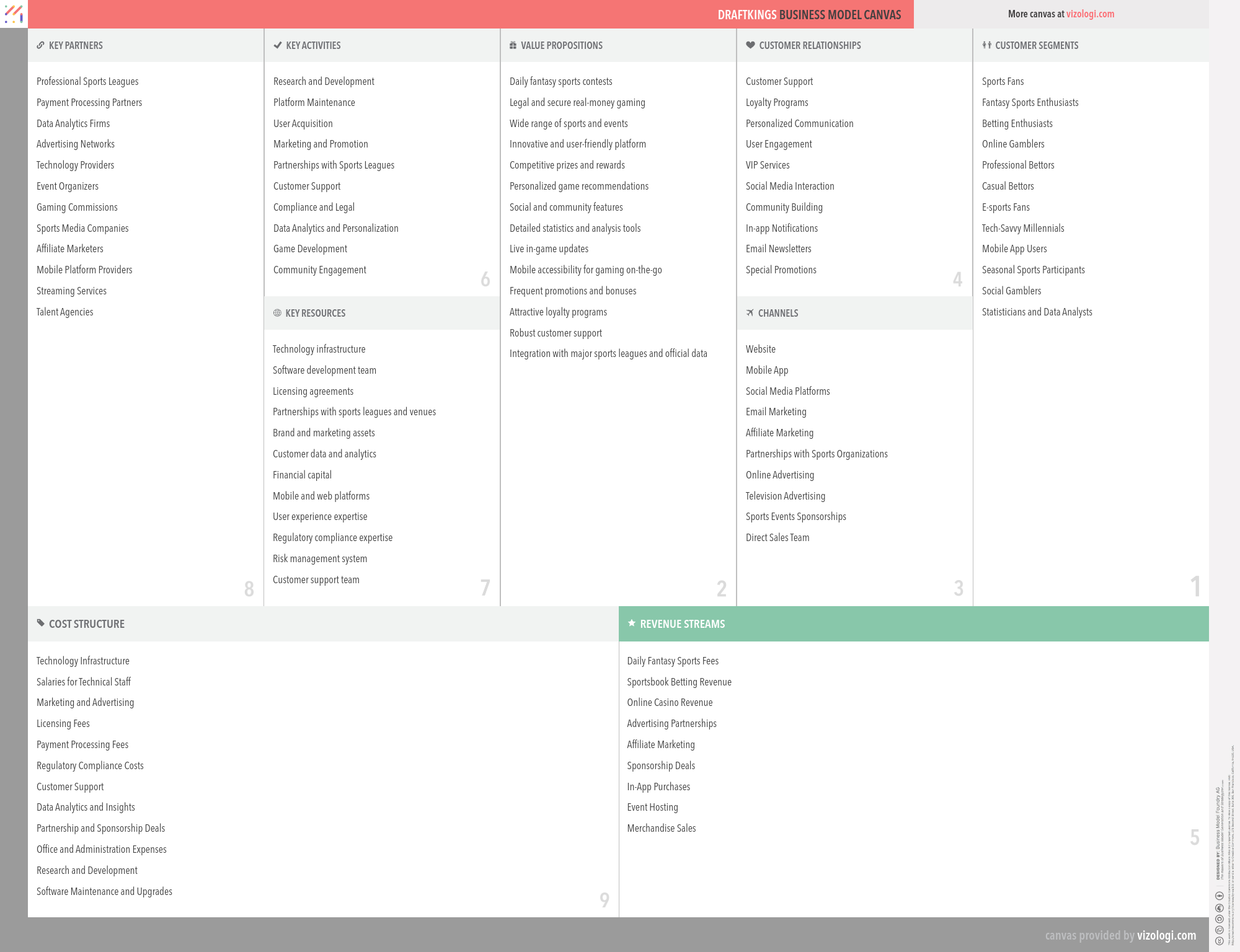
Embed code:

- Professional Sports Leagues
- Payment Processing Partners
- Data Analytics Firms
- Advertising Networks
- Technology Providers
- Event Organizers
- Gaming Commissions
- Sports Media Companies
- Affiliate Marketers
- Mobile Platform Providers
- Streaming Services
- Talent Agencies
- Research and Development
- Platform Maintenance
- User Acquisition
- Marketing and Promotion
- Partnerships with Sports Leagues
- Customer Support
- Compliance and Legal
- Data Analytics and Personalization
- Game Development
- Community Engagement
- Technology infrastructure
- Software development team
- Licensing agreements
- Partnerships with sports leagues and venues
- Brand and marketing assets
- Customer data and analytics
- Financial capital
- Mobile and web platforms
- User experience expertise
- Regulatory compliance expertise
- Risk management system
- Customer support team
- Daily fantasy sports contests
- Legal and secure real-money gaming
- Wide range of sports and events
- Innovative and user-friendly platform
- Competitive prizes and rewards
- Personalized game recommendations
- Social and community features
- Detailed statistics and analysis tools
- Live in-game updates
- Mobile accessibility for gaming on-the-go
- Frequent promotions and bonuses
- Attractive loyalty programs
- Robust customer support
- Integration with major sports leagues and official data
- Customer Support
- Loyalty Programs
- Personalized Communication
- User Engagement
- VIP Services
- Social Media Interaction
- Community Building
- In-app Notifications
- Email Newsletters
- Special Promotions
- Sports Fans
- Fantasy Sports Enthusiasts
- Betting Enthusiasts
- Online Gamblers
- Professional Bettors
- Casual Bettors
- E-sports Fans
- Tech-Savvy Millennials
- Mobile App Users
- Seasonal Sports Participants
- Social Gamblers
- Statisticians and Data Analysts
- Website
- Mobile App
- Social Media Platforms
- Email Marketing
- Affiliate Marketing
- Partnerships with Sports Organizations
- Online Advertising
- Television Advertising
- Sports Events Sponsorships
- Direct Sales Team
- Technology Infrastructure
- Salaries for Technical Staff
- Marketing and Advertising
- Licensing Fees
- Payment Processing Fees
- Regulatory Compliance Costs
- Customer Support
- Data Analytics and Insights
- Partnership and Sponsorship Deals
- Office and Administration Expenses
- Research and Development
- Software Maintenance and Upgrades
- Daily Fantasy Sports Fees
- Sportsbook Betting Revenue
- Online Casino Revenue
- Advertising Partnerships
- Affiliate Marketing
- Sponsorship Deals
- In-App Purchases
- Event Hosting
- Merchandise Sales
DraftKings’s Revenue Model
DraftKings makes money by combining different business models. Below, you will find the list of the different monetization strategies identified for this company:
DraftKings makes money by combining different business models. Below, you will find the list of the different monetization strategies identified for this company:
- Micropayment
- Tradeable currency
- Freemium
- Pay as you go
- Experience
- Digital
- Customer data
- Ecosystem
- Blue ocean strategy
- Codifying a distinctive service capability
- Product innovation
- Corporate innovation
- Affiliation
- Referral
- Mobile first behavior
- Credits
- Sponsorship
- Lean Start-up
Analytics
Market Overview
DraftKings’s Case Study
As experts in the realm of business strategy and company case studies, we find the journey of DraftKings particularly compelling. Since its inception in 2012, DraftKings has transformed from a niche provider of fant...
DraftKings's CASE STUDY
As experts in the realm of business strategy and company case studies, we find the journey of DraftKings particularly compelling. Since its inception in 2012, DraftKings has transformed from a niche provider of fantasy sports contests into a multi-faceted digital sports entertainment powerhouse. By dissecting the company's strategy, operations, and unique business elements, we can glean valuable insights into what makes DraftKings a standout player in the evolving landscape of sports and online gaming.
Building the DraftKings Empire
In the early 2010s, fantasy sports were enjoying a burgeoning popularity, but the market was ripe for disruption. DraftKings, headquartered in Boston, Massachusetts, entered the scene with a mission to revolutionize how fans interacted with sports. Founders Jason Robins, Matt Kalish, and Paul Liberman sought to create a product that merged the excitement of sports fandom with the thrill of competition and wagering. Initially, DraftKings focused on daily and weekly fantasy sports contests, allowing users to draft teams of real athletes and earn points based on their performance.
The company’s early success was driven by a clear understanding of their target audience: avid sports fans who wanted to stay engaged with their favorite games beyond just watching them. By leveraging data analytics and advanced technology, DraftKings offered a unique, user-friendly platform that drew a dedicated following. The model proved effective, with the company reportedly hitting the $1 billion valuation mark by 2015 (TechCrunch, 2015).
Innovating for Diversification
DraftKings didn’t rest on its laurels. Recognizing the potential in expanding its product base, the company ventured into sports betting and iGaming segments. This diversification strategy was not only a response to evolving market opportunities but also a testament to DraftKings' innovative mindset.
The Supreme Court's 2018 decision to lift the federal ban on sports betting opened new avenues for the company. DraftKings quickly capitalized on this legal shift, launching its sportsbook platform. By 2019, DraftKings had become one of the first companies to offer legal online sports betting in the United States. According to Eilers & Krejcik Gaming, DraftKings commanded an 18% share of the online sports betting market in New Jersey alone by 2020 (Eilers & Krejcik Gaming, 2020).
DraftKings’ foray into iGaming, particularly online casino games, further solidified its position as a comprehensive digital entertainment provider. This segment allowed the company to reach an even broader audience, contributing significantly to its revenue diversification. The iGaming revenue amounted to $240 million in 2021, a 91% year-over-year increase (DraftKings Annual Report, 2021).
The Ecosystem Approach
One of the key strategies that sets DraftKings apart is its ecosystem approach. By integrating fantasy sports, sports betting, and iGaming into a single platform, the company ensures a seamless user experience. This integration not only enhances user engagement but also provides multiple avenues for revenue generation.
Users can transition effortlessly between different types of gaming, from drafting fantasy teams to placing bets on live games, all within the same platform. This cohesive ecosystem fosters loyalty and drives repeat usage. Furthermore, it allows DraftKings to cross-promote its services, creating a robust and interconnected revenue model.
The ecosystem is bolstered by an array of data analytics. DraftKings utilizes user data to personalize recommendations, enhancing the user experience and increasing engagement. This approach has been praised by industry experts like Chris Grove, a partner at Eilers & Krejcik Gaming, who noted, "DraftKings’ use of data analytics for personalized user experience is a significant competitive advantage in the crowded digital sports entertainment market" (Grove, 2021).
Revenue Model and Financial Health
DraftKings’ revenue model is as diversified as its product offerings. Key revenue streams include fantasy sports contest entry fees, sports betting vig, and iGaming wagers. In addition, the company monetizes its platform through advertising and sponsorship deals.
The fantasy sports segment remains a crucial revenue driver. Users pay entry fees to participate in contests, and DraftKings takes a percentage as a commission. In the sports betting realm, the company earns revenue through the "vig," the difference between the sum of bets placed and payouts distributed. The iGaming segment, with its variety of casino games, contributes through the house edge retained from wagers.
In 2021, DraftKings reported a revenue of $1.3 billion, a 44% increase from the previous year (DraftKings Annual Report, 2021). This growth showcases the robustness of their multi-channel revenue streams and the ability to capture significant market share across different segments.
Strategic Partnerships and Market Penetration
A critical element of DraftKings’ strategy involves forming strategic partnerships. These partnerships span professional sports leagues, media companies, and technology providers. Notable collaborations include deals with the NFL, NBA, and Major League Baseball, allowing DraftKings to integrate official data and offer exclusive experiences.
In addition, DraftKings has inked agreements with prominent media entities like ESPN, enhancing its brand visibility and accessibility. These partnerships not only drive user acquisition but also lend credibility and legitimacy to DraftKings' offerings.
DraftKings’ strategic relationships extend to technology providers and data analytics firms, ensuring that their platform remains cutting-edge. With a significant portion of its budget allocated to research and development, DraftKings continually innovates to maintain a competitive edge.
User Engagement and Community Building
User engagement remains at the forefront of DraftKings' business model. The company deploys various tactics to engage and retain users, from personalized communication to loyalty programs. By leveraging user data, DraftKings can offer tailored promotions, recommendations, and in-app notifications, enhancing user satisfaction.
Community building is another pillar of DraftKings' user engagement strategy. The platform offers social features that foster a sense of belonging among users. Interactive experiences, such as fantasy leagues and betting pools, create a community atmosphere where users can compete and share experiences.
The Technological Backbone
DraftKings’ technological infrastructure is pivotal to its success. The company boasts a robust platform capable of handling millions of transactions securely and efficiently. This infrastructure is supported by a team of skilled software developers and data scientists who continually refine the user experience.
Furthermore, DraftKings’ mobile-first approach ensures that users can access its services on-the-go. The mobile app accounts for a substantial portion of user activity, reflecting the growing trend of mobile usage in online gaming. As of 2022, mobile traffic contributes to over 65% of DraftKings' total user engagement (Statista, 2022).
Regulatory Compliance and Risk Management
Operating in a highly regulated industry, DraftKings places significant emphasis on compliance and risk management. The company works closely with gaming commissions and regulatory bodies to ensure adherence to legal standards. This approach not only protects the company from legal repercussions but also builds trust with users.
DraftKings employs advanced risk management systems to mitigate financial losses and manage user behavior. These systems are essential for maintaining a fair and secure gaming environment, which is vital for long-term sustainability.
Conclusion
DraftKings' journey from a start-up to a leader in digital sports entertainment is a testament to its innovative approach, diversified product offerings, and robust revenue model. By creating an integrated ecosystem that caters to various facets of sports fandom, DraftKings has redefined how fans interact with sports and gaming.
The company's strategic partnerships, technological infrastructure, and user-centric approach continue to drive its success and growth. As DraftKings navigates the dynamic landscape of digital entertainment, its ability to innovate and adapt will undoubtedly shape its future trajectory.
In examining DraftKings, we see a model of how a company can leverage technology, data, and strategic foresight to capture and sustain market leadership. It will be fascinating to watch how DraftKings continues to evolve and set benchmarks in the years to come.
DraftKings’s Related Competitors
Compare patterns with Betfair, Razer, Zynga...




+100 Business Book Summaries
We’ve distilled the wisdom of influential business books for you.
Zero to One by Peter Thiel.
The Infinite Game by Simon Sinek.
Blue Ocean Strategy by W. Chan.
…