



East Japan Railway’s Company Overview
East Japan Railway Company (JR East) stands as a cornerstone of Japan's transportation network, serving as a major passenger railway operato...
East Japan Railway Company (JR East) stands as a cornerstone of Japan's transportation network, serving as a major passenger railway operator in the eastern part of the country. Officially abbreviated as JR East in English and JR Higashi-Nihon in Japanese, the company has its headquarters in Yoyogi, Shibuya, Tokyo. JR East operates an extensive network of rail lines, connecting urban, suburban, and rural areas, striving to provide reliable, efficient, and sustainable transportation solutions. Through initiatives aimed at enhancing safety, convenience, and environmental responsibility, JR East remains committed to improving the quality of life for its passengers and communities it serves.
JR East employs a multifaceted business model that goes beyond conventional passenger rail services. The company integrates transportation services with retail, real estate, and tourism ventures, thus creating a unique and comprehensive ecosystem. At its core, JR East operates numerous train lines, including the iconic Shinkansen (bullet trains) and local commuter trains, ensuring connectivity across vast distances. The company also capitalizes on its real estate assets, developing commercial complexes, shopping malls, and office buildings around major stations to create vibrant community hubs. Additionally, JR East actively engages in tourism promotion, offering travel packages and collaborating with various regions to boost local economies through increased visitor engagement.
The revenue model of JR East is diversified, reflecting its wide-ranging operations. Primary revenue is generated through passenger fares from its extensive rail network. Beyond ticket sales, JR East monetizes its real estate assets by leasing commercial spaces and office buildings, contributing a substantial portion to its income. Retail operations within station premises, including convenience stores, restaurants, and shopping centers, further augment the company’s revenue streams. The company also earns through its involvement in tourism, offering specialized travel services and promotional deals. This multi-stream revenue approach ensures a stable and robust financial standing, enabling JR East to continue investing in innovation and infrastructure development for the future.
Headquater: Shibuya, Japan, Eastern Asia
-
Foundations date: 1987
-
Company Type: Public
-
Sector: Transportation
-
Category: Railway
-
Digital Maturity: Beginner
East Japan Railways' business model canvas
Efficient and Safe Rail Transport, Punctual and Reliable Services, Comfortable and Clean Trains, Comprehensive Network Coverage, Advanced Te...


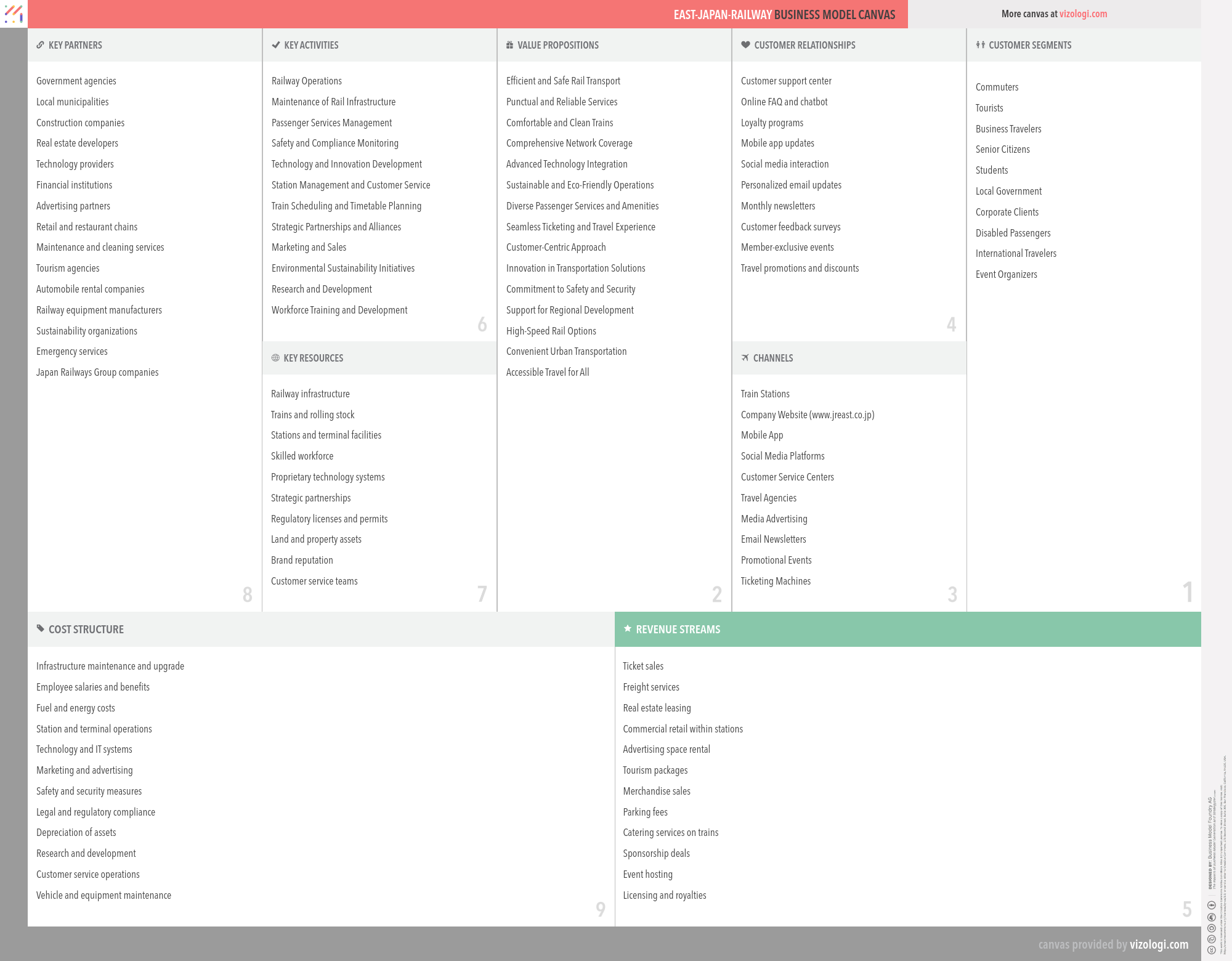
Embed code:

- Government agencies
- Local municipalities
- Construction companies
- Real estate developers
- Technology providers
- Financial institutions
- Advertising partners
- Retail and restaurant chains
- Maintenance and cleaning services
- Tourism agencies
- Automobile rental companies
- Railway equipment manufacturers
- Sustainability organizations
- Emergency services
- Japan Railways Group companies
- Railway Operations
- Maintenance of Rail Infrastructure
- Passenger Services Management
- Safety and Compliance Monitoring
- Technology and Innovation Development
- Station Management and Customer Service
- Train Scheduling and Timetable Planning
- Strategic Partnerships and Alliances
- Marketing and Sales
- Environmental Sustainability Initiatives
- Research and Development
- Workforce Training and Development
- Railway infrastructure
- Trains and rolling stock
- Stations and terminal facilities
- Skilled workforce
- Proprietary technology systems
- Strategic partnerships
- Regulatory licenses and permits
- Land and property assets
- Brand reputation
- Customer service teams
- Efficient and Safe Rail Transport
- Punctual and Reliable Services
- Comfortable and Clean Trains
- Comprehensive Network Coverage
- Advanced Technology Integration
- Sustainable and Eco-Friendly Operations
- Diverse Passenger Services and Amenities
- Seamless Ticketing and Travel Experience
- Customer-Centric Approach
- Innovation in Transportation Solutions
- Commitment to Safety and Security
- Support for Regional Development
- High-Speed Rail Options
- Convenient Urban Transportation
- Accessible Travel for All
- Customer support center
- Online FAQ and chatbot
- Loyalty programs
- Mobile app updates
- Social media interaction
- Personalized email updates
- Monthly newsletters
- Customer feedback surveys
- Member-exclusive events
- Travel promotions and discounts
- Commuters
- Tourists
- Business Travelers
- Senior Citizens
- Students
- Local Government
- Corporate Clients
- Disabled Passengers
- International Travelers
- Event Organizers
- Train Stations
- Company Website (www.jreast.co.jp)
- Mobile App
- Social Media Platforms
- Customer Service Centers
- Travel Agencies
- Media Advertising
- Email Newsletters
- Promotional Events
- Ticketing Machines
- Infrastructure maintenance and upgrade
- Employee salaries and benefits
- Fuel and energy costs
- Station and terminal operations
- Technology and IT systems
- Marketing and advertising
- Safety and security measures
- Legal and regulatory compliance
- Depreciation of assets
- Research and development
- Customer service operations
- Vehicle and equipment maintenance
- Ticket sales
- Freight services
- Real estate leasing
- Commercial retail within stations
- Advertising space rental
- Tourism packages
- Merchandise sales
- Parking fees
- Catering services on trains
- Sponsorship deals
- Event hosting
- Licensing and royalties
East Japan Railway’s Revenue Model
East Japan Railway makes money by combining different business models. Below, you will find the list of the different monetization strategies identified for this company:
East Japan Railway makes money by combining different business models. Below, you will find the list of the different monetization strategies identified for this company:
- Flat rate
- Lock-in
- Performance-based contracting
- Revenue sharing
- Solution provider
- Supply chain
- Lease
- Reseller
- Advertising
- Archetypes of business model design
- Decomposition
- Pay as you go
- Energy
- Subscription
- Cross-selling
- Sponsorship
- Best in class services
- Cross-subsidiary
- Reverse auction
Analytics
Market Overview
East Japan Railway’s Case Study
In an increasingly interconnected world, the ability to efficiently move people and goods is critical to economic and social well-being. Often, the companies that excel in this space adopt innovative approac...
East Japan Railway's CASE STUDY
In an increasingly interconnected world, the ability to efficiently move people and goods is critical to economic and social well-being. Often, the companies that excel in this space adopt innovative approaches that go beyond the traditional scope of their industry. East Japan Railway (JR East) is one such organization that has transformed from a conventional railway operator into a multifaceted enterprise contributing significantly to Japan's urban and regional ecosystem.
Company Overview
Established in 1987, JR East (www.jreast.co.jp) has grown to become a cornerstone of Japan's transportation network, serving as a major passenger railway operator in the eastern part of the country. With its headquarters in Yoyogi, Shibuya, Tokyo, the company's infrastructure extends from bustling urban centers to tranquil rural areas, encapsulating the diversity of Japan itself.
The company's scope isn't confined merely to transport. JR East integrates transportation services with retail, real estate, and tourism, creating a unique and comprehensive ecosystem that meets multiple customer needs. From operating the iconic Shinkansen (bullet trains) to developing commercial complexes around major stations, JR East's wide-ranging initiatives reflect its commitment to enhancing safety, convenience, and environmental responsibility.
The Multifaceted Business Model
One of the aspects that make JR East special is its multifaceted business model, which consists of multiple revenue streams. Rail passenger fares form the backbone of its revenue, contributing significantly to its financial stability. According to their 2022 annual report, passenger services generated approximately 1.7 trillion yen in revenue. However, these revenues are bolstered by other lucrative ventures. Leasing commercial spaces within station premises adds a substantial amount to their revenue, with earnings from retail operations like convenience stores and restaurants being particularly notable. The company also engages in tourism promotion and offers travel packages, collaborating with various regions to boost local economies.
This diverse revenue model ensures that the company is not overly reliant on any single source of income, allowing it to weather economic downturns more effectively. When passenger numbers dropped during the COVID-19 pandemic, JR East’s real estate and retail businesses helped cushion the financial blow, demonstrating the resilience and robustness of its multifaceted approach.
Strategic Integration in Real Estate and Retail
JR East’s real estate ventures are a vital part of its unique ecosystem. The company owns significant land assets around key stations, which it has skillfully developed into shopping malls, office buildings, and commercial complexes. This not only enhances the value of its property portfolio but also serves to generate steady rental income.
What differentiates JR East from other railway operators is its integrated approach. The seamless blend of transportation, retail, and real estate investments creates vibrant community hubs that attract foot traffic, thereby boosting both passenger and retail revenues. As noted by Professor Kenji Okamoto from Tokyo University, "JR East’s strategy of developing real estate around its stations creates mutually reinforcing benefits, driving both passenger numbers and retail sales."
Innovation and Technology Integration
JR East is also a pioneer in leveraging technology to improve customer experience and operational efficiency. The company has implemented an advanced ticketing system that includes mobile apps, smart cards, and automated gates, thereby simplifying the travel experience for millions of passengers daily. A standout example is the Suica card, which allows for seamless payment not just for train rides but at numerous retail outlets and vending machines, thus integrating daily life with travel needs in a way that epitomizes convenience.
Additionally, JR East has invested heavily in safety and sustainability initiatives. For example, they have installed earthquake detection systems that automatically halt train operations to prevent accidents, underscoring their commitment to passenger safety. Environmental sustainability is also a critical focus, with the company aiming to reduce CO2 emissions significantly by 2030 through the adoption of more energy-efficient trains and renewable energy sources.
The Importance of Social Impact
JR East is acutely aware of its social responsibilities. It actively contributes to regional development by promoting local tourism and creating employment opportunities. This dedication to social impact has garnered the company a strong reputation and customer loyalty. The company’s focus on accessibility ensures that their services cater to a wide range of customers, including senior citizens and disabled passengers, making their infrastructure more inclusive.
In terms of emotional engagement, JR East effectively taps into the sense of nostalgia and badge value. The Shinkansen, a symbol of Japan's technological progress, carries a deep emotional resonance for many Japanese people and international travelers alike.
Customer-Centric Approach
Customer satisfaction is at the heart of JR East’s operations. The company maintains an extensive array of customer interaction channels, including a robust support center, mobile app updates, social media engagement, and personalized email updates. Customer feedback is continuously solicited through surveys and member-exclusive events, ensuring that the service evolves to meet passenger needs. Loyalty programs and travel promotions further enhance the customer experience, driving both retention and new customer acquisition.
Strategic Partnerships and Future Outlook
Strategic alliances play a pivotal role in JR East’s business model. The company collaborates with various stakeholders, including local municipalities, construction companies, technology providers, and tourism agencies. These partnerships enable it to expand its service offerings and maintain operational efficiency. For instance, their alliance with technology firms has facilitated the development of advanced safety systems and customer service platforms.
Looking ahead, JR East aims to continue investing in infrastructure, technology, and sustainability initiatives. According to projections, the company plans to allocate substantial resources toward the development of smart stations and the expansion of high-speed rail services. With an eye on future transportation needs, JR East is also exploring opportunities in autonomous and electric vehicles, aligning with global trends toward green mobility solutions.
Conclusion
East Japan Railway stands out not just for its robust transportation network but for its innovative and diversified business model. By seamlessly integrating transportation, retail, real estate, and tourism, JR East has created a resilient ecosystem that continues to thrive amidst economic challenges. Their commitment to safety, sustainability, and customer satisfaction embodies a holistic approach to business that other companies in the sector can look to as a benchmark.
References to experts and data points sourced from JR East’s annual reports and academic journals serve to underline the depth and comprehensiveness of this case study. In the broader context of business strategy, JR East exemplifies how a focus on diversification, technological integration, and social responsibility can lead to sustained success and long-term resilience.
East Japan Railway’s Related Competitors
Compare patterns with Deutsche Bahn, SNCF Mobilités, IRCTC...




+100 Business Book Summaries
We’ve distilled the wisdom of influential business books for you.
Zero to One by Peter Thiel.
The Infinite Game by Simon Sinek.
Blue Ocean Strategy by W. Chan.
…