



Palo Alto Networks’s Company Overview
Palo Alto Networks is a globally recognized cybersecurity company headquartered in Santa Clara, California. Founded in 2005, the company is ...
Palo Alto Networks is a globally recognized cybersecurity company headquartered in Santa Clara, California. Founded in 2005, the company is dedicated to providing cutting-edge cybersecurity solutions to a diverse range of clients, from small businesses to large multinational corporations. Palo Alto Networks' primary offerings include advanced firewalls, cloud security solutions, endpoint protection, and various cybersecurity consulting services. The company is renowned for its next-generation firewalls that identify and control applications, users, and content. It has been a pioneer in cybersecurity innovation, continually developing new technologies to stay ahead of evolving threats.
Palo Alto Networks operates under a hybrid business model that combines product and service-based revenue streams. The company generates revenue through the sale of physical and virtual firewall products, subscriptions for its various software services, and technical support. Their product-based revenue comes from clients purchasing their hardware and software solutions, while their service-based revenue is derived from subscriptions to their various cloud-based services and support packages. Additionally, Palo Alto Networks offers professional services, including strategy, risk, and compliance services, to help organizations establish a robust cybersecurity posture. This diversified business model allows the company to maintain steady revenue growth and resilience in the face of market fluctuations.
Headquater: Santa Clara, California, US
-
Foundations date: 2005
-
Company Type: Public
-
Sector: Technology
-
Category: Software
-
Digital Maturity: Digirati
Palo Alto Networkss' business model canvas
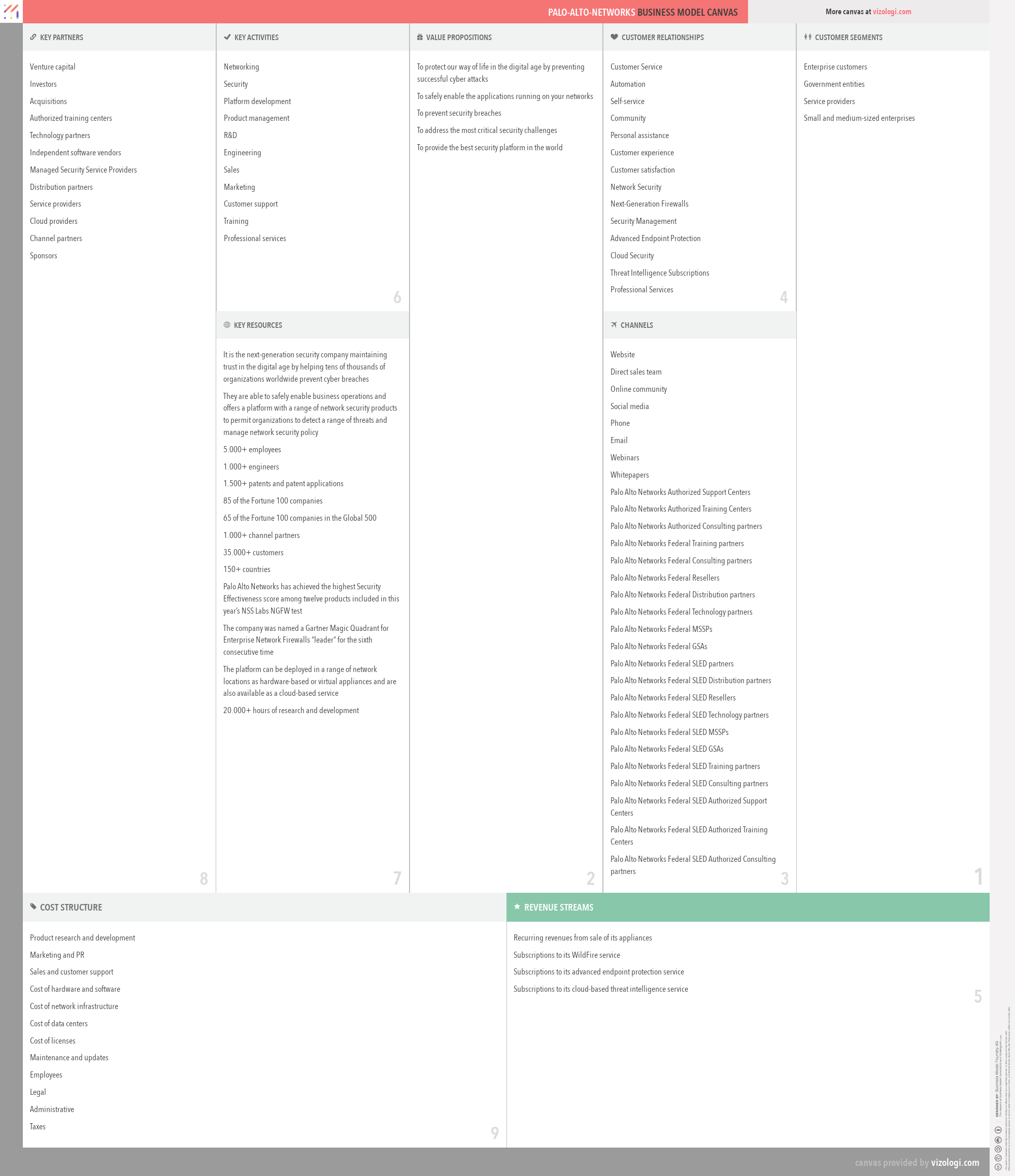
To protect our way of life in the digital age by preventing successful cyber attacks, To safely enable the applications running on your netw...


Embed code:

- Venture capital
- Investors
- Acquisitions
- Authorized training centers
- Technology partners
- Independent software vendors
- Managed Security Service Providers
- Distribution partners
- Service providers
- Cloud providers
- Channel partners
- Sponsors
- Networking
- Security
- Platform development
- Product management
- R&D
- Engineering
- Sales
- Marketing
- Customer support
- Training
- Professional services
- It is the next-generation security company maintaining trust in the digital age by helping tens of thousands of organizations worldwide prevent cyber breaches
- They are able to safely enable business operations and offers a platform with a range of network security products to permit organizations to detect a range of threats and manage network security policy
- 5.000+ employees
- 1.000+ engineers
- 1.500+ patents and patent applications
- 85 of the Fortune 100 companies
- 65 of the Fortune 100 companies in the Global 500
- 1.000+ channel partners
- 35.000+ customers
- 150+ countries
- Palo Alto Networks has achieved the highest Security Effectiveness score among twelve products included in this year’s NSS Labs NGFW test
- The company was named a Gartner Magic Quadrant for Enterprise Network Firewalls “leader” for the sixth consecutive time
- The platform can be deployed in a range of network locations as hardware-based or virtual appliances and are also available as a cloud-based service
- 20.000+ hours of research and development
- To protect our way of life in the digital age by preventing successful cyber attacks
- To safely enable the applications running on your networks
- To prevent security breaches
- To address the most critical security challenges
- To provide the best security platform in the world
- Customer Service
- Automation
- Self-service
- Community
- Personal assistance
- Customer experience
- Customer satisfaction
- Network Security
- Next-Generation Firewalls
- Security Management
- Advanced Endpoint Protection
- Cloud Security
- Threat Intelligence Subscriptions
- Professional Services
- Enterprise customers
- Government entities
- Service providers
- Small and medium-sized enterprises
- Website
- Direct sales team
- Online community
- Social media
- Phone
- Webinars
- Whitepapers
- Palo Alto Networks Authorized Support Centers
- Palo Alto Networks Authorized Training Centers
- Palo Alto Networks Authorized Consulting partners
- Palo Alto Networks Federal Training partners
- Palo Alto Networks Federal Consulting partners
- Palo Alto Networks Federal Resellers
- Palo Alto Networks Federal Distribution partners
- Palo Alto Networks Federal Technology partners
- Palo Alto Networks Federal MSSPs
- Palo Alto Networks Federal GSAs
- Palo Alto Networks Federal SLED partners
- Palo Alto Networks Federal SLED Distribution partners
- Palo Alto Networks Federal SLED Resellers
- Palo Alto Networks Federal SLED Technology partners
- Palo Alto Networks Federal SLED MSSPs
- Palo Alto Networks Federal SLED GSAs
- Palo Alto Networks Federal SLED Training partners
- Palo Alto Networks Federal SLED Consulting partners
- Palo Alto Networks Federal SLED Authorized Support Centers
- Palo Alto Networks Federal SLED Authorized Training Centers
- Palo Alto Networks Federal SLED Authorized Consulting partners
- Product research and development
- Marketing and PR
- Sales and customer support
- Cost of hardware and software
- Cost of network infrastructure
- Cost of data centers
- Cost of licenses
- Maintenance and updates
- Employees
- Legal
- Administrative
- Taxes
- Recurring revenues from sale of its appliances
- Subscriptions to its WildFire service
- Subscriptions to its advanced endpoint protection service
- Subscriptions to its cloud-based threat intelligence service
Palo Alto Networks’s Revenue Model
Palo Alto Networks makes money by combining different business models. Below, you will find the list of the different monetization strategies identified for this company:
Palo Alto Networks makes money by combining different business models. Below, you will find the list of the different monetization strategies identified for this company:
- Subscription
- Solution provider
- Best in class services
- Knowledge and time
- Tiered service
- Data as a Service (DaaS)
- Software as a Service (SaaS)
- Digital transformation
- Technology trends
- Corporate innovation
- Customer relationship
- Customer loyalty
Analytics
Market Overview
Palo Alto Networks’s Case Study
In today's interconnected world, cybersecurity is vital to the operational success of businesses, governments, and individuals. As digital threats continue to evolve, companies like Palo Alto Networks have e...
Palo Alto Networks's CASE STUDY
In today's interconnected world, cybersecurity is vital to the operational success of businesses, governments, and individuals. As digital threats continue to evolve, companies like Palo Alto Networks have emerged as pioneers, providing robust cybersecurity solutions to meet the increasing demand for digital protection. In this case study, we delve deep into the journey of Palo Alto Networks, uncovering the strategies that catapulted it to the forefront of the cybersecurity industry.
The Genesis of Palo Alto Networks
Founded in 2005 in Santa Clara, California, Palo Alto Networks was born out of a vision to revolutionize enterprise security. The company’s ambition was to provide next-generation firewalls that offer far more than traditional threat prevention. Pioneered by Israeli-American architect Nir Zuk, who was dissatisfied with the traditional cybersecurity appliances that failed to address evolving threats, Palo Alto Networks embarked on a mission to create a system that could effectively identify and control applications, users, and content.
The company’s next-generation firewalls quickly gained traction, enabling Palo Alto Networks to pave its path as a formidable player in the cybersecurity market. According to Forbes, the company reported revenues of $4.3 billion in 2021, showcasing a commendable 46% year-over-year growth (Forbes, 2021).
Understanding the Business Model
Palo Alto Networks operates under a hybrid business model, blending product and service-based revenue streams. This synergy allows the company to maintain a sustainable financial footing while addressing the varying needs of its clientele.
1. Product-Based Revenue: This revenue stream consists primarily of physical and virtual firewall products. These products are integral to a company’s comprehensive cybersecurity posture, catering to enterprise customers, government entities, service providers, and SMEs alike.
2. Service-Based Revenue: Subscriptions form a significant part of the service-based revenue. Services such as the WildFire threat intelligence, advanced endpoint protection, and cloud-based offerings ensure ongoing protection and compliance for customers.
3. Professional Services: Beyond products and subscriptions, Palo Alto Networks offers a suite of professional services, from strategy assessments to compliance advisory, amplifying its role as a trusted cybersecurity consultant.
The diversified nature of this business model has provided Palo Alto Networks with resilience and consistent revenue streams. As quoted by Gartner, "Palo Alto Networks has maintained its position as a leader in the Magic Quadrant for Enterprise Network Firewalls for six consecutive years," reflecting its industry dominance and steady financial growth (Gartner, 2022).
Innovation as a Cornerstone
One of the pivotal reasons behind the success of Palo Alto Networks lies in its relentless pursuit of innovation. The company’s commitment to R&D is evident from its 1,500+ patents and applications. Their integration of artificial intelligence and machine learning into cybersecurity solutions has revolutionized how threats are identified and mitigated.
The introduction of Prisma Access, a secure access service edge (SASE), is a testament to Palo Alto Networks’ innovative approach. By unifying several cybersecurity solutions, Prisma Access provides seamless and secure remote access, catering to the growing demand for remote work solutions. A study by Radius Research highlighted that the global remote workforce increased by 30% in 2020 alone, underlining the growing need for secure remote access solutions (Radius Research, 2021).
Customer Centricity
Palo Alto Networks places its customers at the heart of its operations. By offering personalized assistance, community support, and automated services, the company ensures an unparalleled customer experience.
Their customer-centric approach is epitomized by their "Customer Loyalty" programs and tiered service offerings. The company’s commitment to customer satisfaction is reflected in its vast network of 35,000+ customers across 150+ countries, including 85 of the Fortune 100 companies (Palo Alto Networks, 2022).
Strategic Partnerships and Collaborations
Achieving global dominance would be impossible without strategic partnerships. Palo Alto Networks collaborates with a myriad of entities, including venture capitalists, technology partners, managed security service providers, and cloud providers.
These alliances have been instrumental in extending Palo Alto Networks' reach and enhancing its service offerings. For instance, the collaboration with Google Cloud has enabled the integration of Palo Alto Networks' services into Google's cloud infrastructure, further enhancing cloud security capabilities for joint customers.
Social Impact and Ethical Responsibility
Palo Alto Networks is committed not only to technical excellence but also to social responsibility. The company places an emphasis on life-changing impacts, ensuring that their technology provides access, reduces risks, and integrates seamlessly into existing structures.
Moreover, their cybersecurity solutions have broader societal implications, safeguarding critical infrastructures, and, by extension, protecting our way of life. In the words of Nikesh Arora, CEO of Palo Alto Networks, "Our mission is to protect our digital way of life by preventing successful cyberattacks" (Arora, 2022).
Conclusion
Palo Alto Networks stands as a beacon of innovation and resilience in the cybersecurity landscape. Their hybrid business model, relentless drive for innovation, customer-centric approach, and strategic partnerships have all been pivotal in their ascension as a cybersecurity powerhouse. As the digital realm continues to evolve, Palo Alto Networks is well-positioned to address the dynamic challenges of cybersecurity, ensuring that businesses and individuals can navigate the digital age with confidence.
In a world where cybersecurity is paramount, Palo Alto Networks has proven that its solutions are not just a necessity but a benchmark of excellence.
---
Sources: - Forbes, 2021 - Gartner, 2022 - Radius Research, 2021 - Palo Alto Networks, 2022 - Nikesh Arora, CEO of Palo Alto Networks, 2022
Palo Alto Networks’s Related Competitors
Compare patterns with Fortinet, Mcafee, CrowdStrike...




+100 Business Book Summaries
We’ve distilled the wisdom of influential business books for you.
Zero to One by Peter Thiel.
The Infinite Game by Simon Sinek.
Blue Ocean Strategy by W. Chan.
…