



Patreon’s Company Overview
Patreon, Inc. revolutionizes the way content creators and artists monetize their work by offering a comprehensive platform at http://www.pat...
Patreon, Inc. revolutionizes the way content creators and artists monetize their work by offering a comprehensive platform at http://www.patreon.com. Patreon connects creators with their patrons, providing them with the means to share and monetize a vast variety of content, including videos, podcasts, artwork, music, and more. This platform is particularly suited for artists, musicians, writers, and other content creators seeking a dependable income stream without relying on traditional advertising or sponsorship models. By fostering direct relationships between creators and their audiences, Patreon empowers creative professionals to focus on producing high-quality content rather than worrying about the financial sustainability of their craft.
Patreon employs a unique business model centered on direct patronage, enabling creators to receive consistent funding from their supporters. Unlike traditional models, where creators often depend on unpredictable ad revenue or one-time purchases, Patreon operates on a subscription-based model wherein patrons pledge a specific amount monthly or per creation. This system not only provides creators with a stable and predictable income stream but also strengthens the connection between creators and their most dedicated fans. By offering tiered membership levels, creators can provide exclusive content and benefits to their supporters, enhancing the value proposition for patrons and ensuring a more engaged community.
The revenue model of Patreon is designed to sustain its operations by taking a percentage of the earnings of creators hosted on the platform. Patreon offers multiple plans tailored to different types of creators, with varying levels of services and fees associated. Typically, Patreon charges a commission ranging from 5% to 12% of creators' monthly income, depending on the service plan selected. This includes transaction fees and additional services, such as customer support, analytics, and promotional tools. Through this structure, Patreon ensures its own financial viability while providing creators with the tools they need to grow and maintain their patron base, ultimately fostering a vibrant ecosystem where creativity thrives.
Headquater: San Francisco, California, US
-
Foundations date: 2013
-
Company Type: Private
-
Sector: Information & Media
-
Category: Entertainment
-
Digital Maturity: Digirati
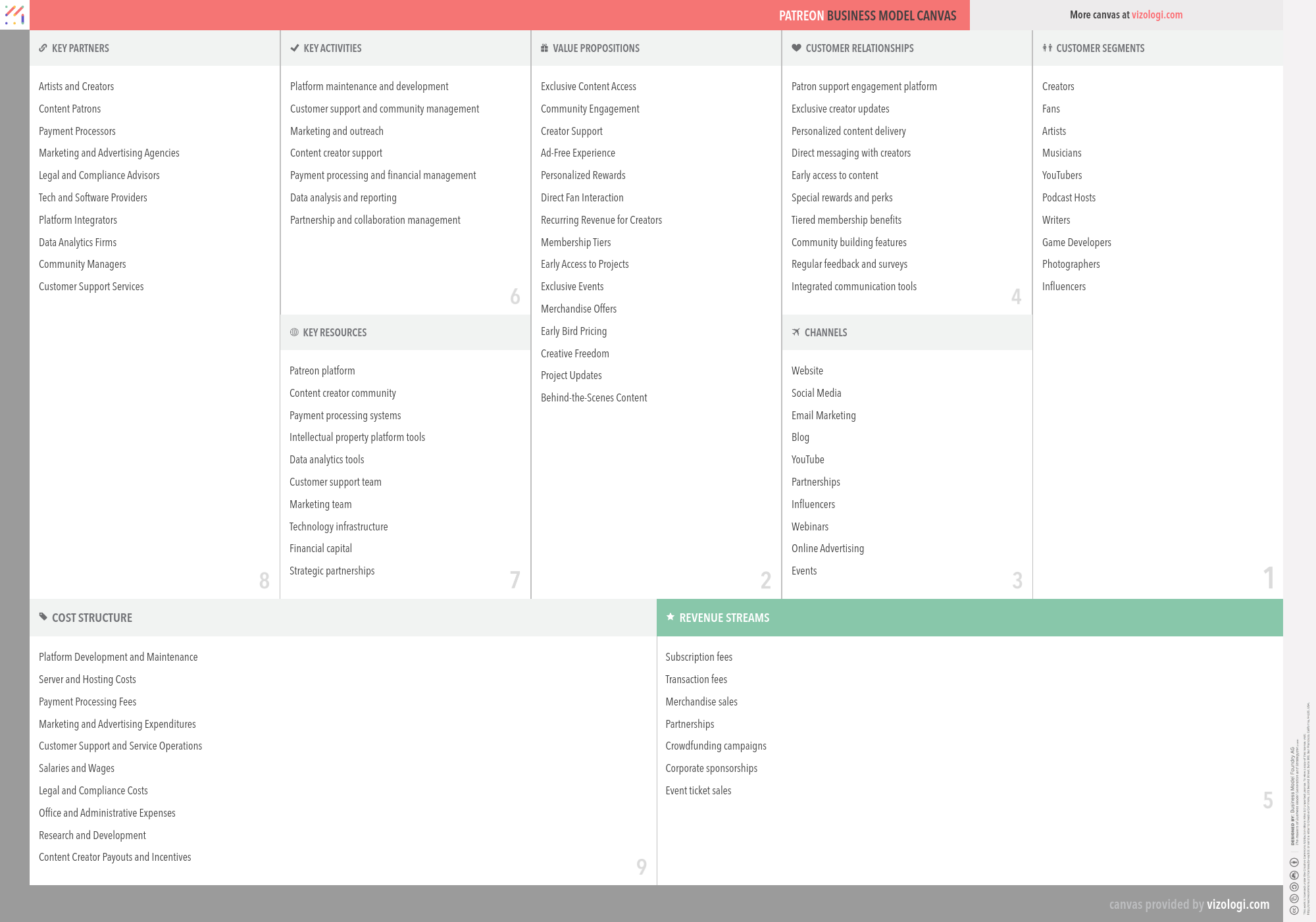
Patreons' business model canvas
Exclusive Content Access, Community Engagement, Creator Support, Ad-Free Experience, Personalized Rewards, Direct Fan Interaction, Recurring...


Embed code:

- Artists and Creators
- Content Patrons
- Payment Processors
- Marketing and Advertising Agencies
- Legal and Compliance Advisors
- Tech and Software Providers
- Platform Integrators
- Data Analytics Firms
- Community Managers
- Customer Support Services
- Platform maintenance and development
- Customer support and community management
- Marketing and outreach
- Content creator support
- Payment processing and financial management
- Data analysis and reporting
- Partnership and collaboration management
- Patreon platform
- Content creator community
- Payment processing systems
- Intellectual property platform tools
- Data analytics tools
- Customer support team
- Marketing team
- Technology infrastructure
- Financial capital
- Strategic partnerships
- Exclusive Content Access
- Community Engagement
- Creator Support
- Ad-Free Experience
- Personalized Rewards
- Direct Fan Interaction
- Recurring Revenue for Creators
- Membership Tiers
- Early Access to Projects
- Exclusive Events
- Merchandise Offers
- Early Bird Pricing
- Creative Freedom
- Project Updates
- Behind-the-Scenes Content
- Patron support engagement platform
- Exclusive creator updates
- Personalized content delivery
- Direct messaging with creators
- Early access to content
- Special rewards and perks
- Tiered membership benefits
- Community building features
- Regular feedback and surveys
- Integrated communication tools
- Creators
- Fans
- Artists
- Musicians
- YouTubers
- Podcast Hosts
- Writers
- Game Developers
- Photographers
- Influencers
- Website
- Social Media
- Email Marketing
- Blog
- YouTube
- Partnerships
- Influencers
- Webinars
- Online Advertising
- Events
- Platform Development and Maintenance
- Server and Hosting Costs
- Payment Processing Fees
- Marketing and Advertising Expenditures
- Customer Support and Service Operations
- Salaries and Wages
- Legal and Compliance Costs
- Office and Administrative Expenses
- Research and Development
- Content Creator Payouts and Incentives
- Subscription fees
- Transaction fees
- Merchandise sales
- Partnerships
- Crowdfunding campaigns
- Corporate sponsorships
- Event ticket sales
Patreon’s Revenue Model
Patreon makes money by combining different business models. Below, you will find the list of the different monetization strategies identified for this company:
Patreon makes money by combining different business models. Below, you will find the list of the different monetization strategies identified for this company:
- Brokerage
- Two-sided market
- Subscription
- Sponsorship
- Membership club
- Crowdsourcing
- Crowdfunding
- Pay what you want
- Pay as you go
- Online marketplace
- On-demand economy
- Lean Start-up
- Corporate renaissance
- Benchmarking services
- Disruptive trends
- Disintermediation
- Digitization
- Network builders
- New job trends
- Mobile first behavior
- Ecosystem
- User design
- Referral
- Discount club
- Radical transparency
- Product innovation
- Take the wheel
- Tag management
Analytics
Market Overview
Patreon’s Case Study
In the realm of monetizing creative work, few platforms have revolutionized the landscape quite like Patreon. Founded in 2013, Patreon offers an innovative approach that fosters direct financial support between creator...
Patreon's Case Study
In the realm of monetizing creative work, few platforms have revolutionized the landscape quite like Patreon. Founded in 2013, Patreon offers an innovative approach that fosters direct financial support between creators and their audiences. Located in San Francisco, California, the platform enables artists, musicians, writers, and other content creators to secure consistent funding from their supporters. As we delve into this case study, we'll explore what makes Patreon unique, examine its business model, and understand its impact on the creative economy.
The Genesis of Patreon
Patreon emerged from a problem faced by its co-founder, musician Jack Conte. Conte found that despite having a substantial online following, monetizing his art through traditional advertising or one-off sales was a tumultuous endeavor. Seeing the frustration of many creators who were grappling with similar struggles, Conte and Samuel Yam conceived Patreon as a solution, focusing on direct patronage. This model resonates with historical patterns of patronage but is digitally sculpted to meet modern needs.
The Unique Business Model
Patreon's business model revolves around facilitating patronage through a subscription-based platform. Unlike conventional methods where creators rely on unpredictable ad revenue or sporadic purchases, Patreon offers a steadier income stream. Patrons pledge a specific amount on a monthly basis or per creation, providing consistent funding.
According to Patreon, over 200,000 creators have collectively earned more than $2 billion through the platform (Patreon, 2023). These numbers underscore the platform's efficacy in providing a reliable income stream for creators.
The Tiers and Rewards System
A distinguishing feature of Patreon is its tiered membership levels, which allow creators to offer exclusive content and benefits to their supporters. Creators can design their tiers with varying price points and perks, catering to different segments of their audience. This not only enhances the value proposition for patrons but also promotes a sense of community and belonging.
Revenue Streams and Monetization
The revenue model for Patreon is dual-faceted: a commission-based system coupled with tiered service plans. Depending on the plan, Patreon charges a commission ranging from 5% to 12% of a creator's monthly income. The platform also levies transaction fees. These earnings enable Patreon to provide essential services like customer support, analytics, and promotion tools, while ensuring its financial sustainability.
Data shows that creators can increase their monthly income by as much as 50% during the first six months of joining Patreon (Patreon, 2023). This remarkable statistic highlights the platform's capability to substantially augment creators' earnings, fostering a more vibrant creative ecosystem.
Scaling Creative Connections
A pivotal element of Patreon's success is its ability to scale connections between creators and patrons. By facilitating direct engagement, it empowers creators to invest more time in crafting high-quality content. In essence, Patreon allows creators to focus on their art rather than the intricacies of financial management, which in turn elevates the overall quality and quantity of creative output.
Industry Impact and Expert Opinions
The impact of Patreon on the creative industry has been profound. Forbes acknowledged Patreon as a game-changer for artists seeking financial independence (Forbes, 2021). Einav, an economist at Stanford University, emphasized that platforms like Patreon democratize access to financial support, making it feasible for niche creators to thrive (Einav, 2022).
Moreover, the cultural implications of Patreon's model are significant. As more creators can sustain themselves, the diversity and depth of available content increase, enriching the broader cultural landscape. This trend aligns with sociologist Mark Banks' research indicating that direct creator-fan relationships can disrupt traditional gatekeeping in the arts and media sector (Banks, 2019).
Patreon's Technological Backbone
Behind the scenes, Patreon relies on a robust technological infrastructure. Payment processing systems, data analytics tools, and customer support frameworks are pivotal in maintaining seamless operations. These resources enable creators to focus on their craft while Patreon handles the logistical challenges.
Market Position and Competitive Edge
Patreon's market position is strengthened by its nuanced understanding of creators' needs. Unlike other platforms that prioritize advertisers or sponsors, Patreon centers on the creators' relationship with their audience. This focus on direct patronage creates a more sustainable and mutually beneficial model.
The statistics back this up: 87% of creators on Patreon reported an improvement in their creative output due to the financial stability offered by the platform (Patreon Creator Census, 2022).
Adapting and Innovating
Patreon's ability to adapt and innovate continually sets it apart. Over the years, it has introduced features like annual memberships and goal-setting tools to help creators strategize and optimize their growth. Moreover, the platform’s emphasis on community-building tools, such as exclusive creator updates and direct messaging, keeps it attuned to the evolving needs of both creators and patrons.
Conclusion
Patreon stands as a testament to the transformative potential of direct patronage in the digital age. By enabling creators to forge stronger connections with their most dedicated supporters, Patreon not only secures a stable financial foundation for artists but also enriches the cultural fabric at large.
In an era where traditional monetization models often fall short, Patreon’s subscription-based approach fosters creativity and innovation. As the platform evolves, its commitment to empowering creators ensures that it will remain a pivotal player in the creative economy for years to come.
Patreon’s Related Competitors
Compare patterns with Tiktok, iPod / iTunes, Geek & Sundry...




+100 Business Book Summaries
We’ve distilled the wisdom of influential business books for you.
Zero to One by Peter Thiel.
The Infinite Game by Simon Sinek.
Blue Ocean Strategy by W. Chan.
…