



Sears’s Company Overview
Sears, a venerable name in American retail, has evolved to become a multifaceted shopping destination catering to a wide array of consumer n...
Sears, a venerable name in American retail, has evolved to become a multifaceted shopping destination catering to a wide array of consumer needs through its online platform, https://www.sears.com. Founded in 1886, Sears has a longstanding tradition of offering diverse product categories including appliances, consumer electronics, tools, lawn and garden equipment, apparel, footwear, jewelry, and automotive services. The company's mission is to provide quality products and services that enhance the lives of their customers, building on a rich history of trust and retail innovation. From home essentials to lifestyle products, Sears connects with millions of customers through a seamless and user-friendly online shopping experience.
Sears' business model focuses on combining the convenience of digital retail with the legacy of a trusted brand. The company has shifted from its historical dependence on physical stores to a robust e-commerce platform, enabling a more flexible and expansive reach. This transition allows Sears to adapt to changing consumer behaviors and market trends while preserving its commitment to quality and customer service. The platform not only offers a wide variety of products but also integrates services like home delivery, installation, and repair, creating a comprehensive shopping ecosystem. Furthermore, Sears leverages its iconic brands such as Kenmore, Craftsman, and DieHard to maintain a competitive edge in the market.
The revenue model of Sears is built on multiple streams that drive financial sustainability. The company generates income through direct sales of its wide-ranging merchandise offered via the online platform. Additionally, Sears retains profitability by providing specialized services, including installation, repair, and home improvement solutions, which are often bundled with product purchases. The company also operates a loyalty program, known as Shop Your Way, which incentivizes repeat purchases and fosters customer loyalty through personalized offers and rewards. By diversifying its revenue channels, Sears ensures a steady and resilient income flow while continuing to innovate in the retail landscape.
Headquater: Hoffman Estates, Illinois, US
-
Foundations date: 1886
-
Company Type: Subsidiary
-
Sector: Consumer Goods
-
Category: Retail
-
Digital Maturity: Beginner
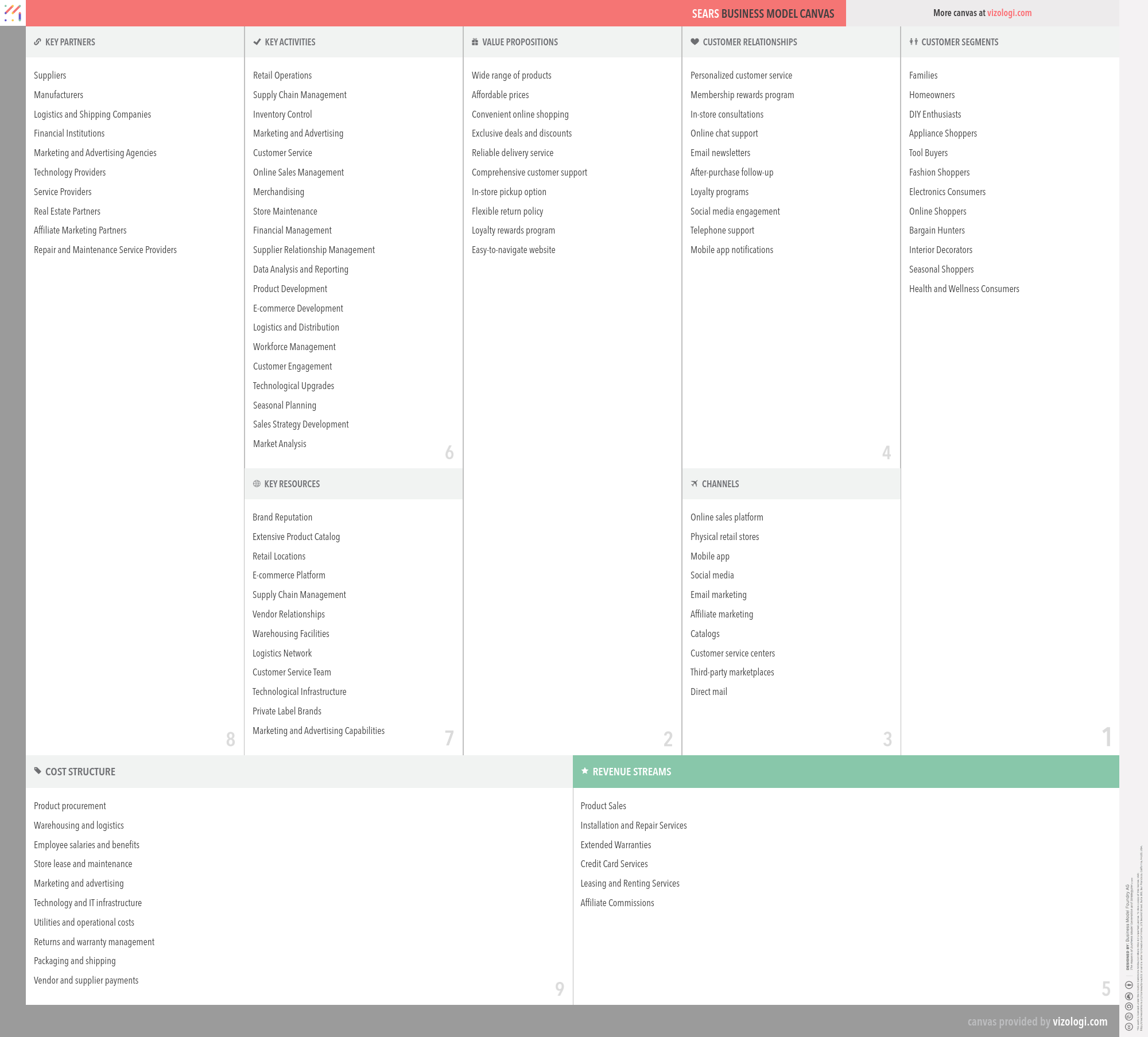
Searss' business model canvas
Wide range of products, Affordable prices, Convenient online shopping, Exclusive deals and discounts, Reliable delivery service, Comprehensi...


Embed code:

- Suppliers
- Manufacturers
- Logistics and Shipping Companies
- Financial Institutions
- Marketing and Advertising Agencies
- Technology Providers
- Service Providers
- Real Estate Partners
- Affiliate Marketing Partners
- Repair and Maintenance Service Providers
- Retail Operations
- Supply Chain Management
- Inventory Control
- Marketing and Advertising
- Customer Service
- Online Sales Management
- Merchandising
- Store Maintenance
- Financial Management
- Supplier Relationship Management
- Data Analysis and Reporting
- Product Development
- E-commerce Development
- Logistics and Distribution
- Workforce Management
- Customer Engagement
- Technological Upgrades
- Seasonal Planning
- Sales Strategy Development
- Market Analysis
- Brand Reputation
- Extensive Product Catalog
- Retail Locations
- E-commerce Platform
- Supply Chain Management
- Vendor Relationships
- Warehousing Facilities
- Logistics Network
- Customer Service Team
- Technological Infrastructure
- Private Label Brands
- Marketing and Advertising Capabilities
- Wide range of products
- Affordable prices
- Convenient online shopping
- Exclusive deals and discounts
- Reliable delivery service
- Comprehensive customer support
- In-store pickup option
- Flexible return policy
- Loyalty rewards program
- Easy-to-navigate website
- Personalized customer service
- Membership rewards program
- In-store consultations
- Online chat support
- Email newsletters
- After-purchase follow-up
- Loyalty programs
- Social media engagement
- Telephone support
- Mobile app notifications
- Families
- Homeowners
- DIY Enthusiasts
- Appliance Shoppers
- Tool Buyers
- Fashion Shoppers
- Electronics Consumers
- Online Shoppers
- Bargain Hunters
- Interior Decorators
- Seasonal Shoppers
- Health and Wellness Consumers
- Online sales platform
- Physical retail stores
- Mobile app
- Social media
- Email marketing
- Affiliate marketing
- Catalogs
- Customer service centers
- Third-party marketplaces
- Direct mail
- Product procurement
- Warehousing and logistics
- Employee salaries and benefits
- Store lease and maintenance
- Marketing and advertising
- Technology and IT infrastructure
- Utilities and operational costs
- Returns and warranty management
- Packaging and shipping
- Vendor and supplier payments
- Product Sales
- Installation and Repair Services
- Extended Warranties
- Credit Card Services
- Leasing and Renting Services
- Affiliate Commissions
Sears’s Revenue Model
Sears makes money by combining different business models. Below, you will find the list of the different monetization strategies identified for this company:
Sears makes money by combining different business models. Below, you will find the list of the different monetization strategies identified for this company:
- Direct selling
- Cross-selling
- Cross-subsidiary
- eCommerce
- Niche retail
- Curated retail
- Solution provider
- Membership club
- Discount club
- Credits
- Customer loyalty
- Best in class services
- Decomposition
- Archetypes of business model design
- Enterprise unbundled
- Online marketplace
- On-demand economy
- Mobile first behavior
- Long tail
- Regular replacement
- Supermarket
- Shop in shop
Analytics
Market Overview
Sears’s Case Study
As we dive deep into the rich legacy of one of America's most venerable retail giants, Sears, it becomes clear that the company's journey offers profound insights into the evolution and resilience of retail businesses. F...
Sears's CASE STUDY
As we dive deep into the rich legacy of one of America's most venerable retail giants, Sears, it becomes clear that the company's journey offers profound insights into the evolution and resilience of retail businesses. Founded in 1886, Sears stands as a testament to adaptability and innovation in a highly competitive market. With its seamless transition from an extensive chain of physical stores to a robust e-commerce platform, Sears continues to engage millions of customers, striking a balance between tradition and modernity.
Evolution through Innovation
Sears embarked on its retail journey by catering to the rural American consumer through its iconic mail-order catalog. The catalog was an early example of strategic outreach, leveraging written media to captivate the masses. In the early 20th century, Sears was responsible for 3 percent of every retail purchase in the United States. This shows the immense scale and influence Sears had in American retail (The Rise and Fall of Sears, Kenmore, and DieHard Brands, CNN Business, 2020).
Transitioning to physical stores in the mid-20th century, Sears transformed into a hub for home essentials, appliances, and automotive products. What made Sears uniquely special was not just its diversification of product offerings but its emphasis on private brands like Kenmore, Craftsman, and DieHard—an approach that bolstered customer loyalty.
The Digital Leap
In response to the digital revolution, Sears adapted by launching its online platform, https://www.sears.com. This strategic move was designed to capture the growing segment of online shoppers while maintaining the legacy of trust and quality. The online platform offers an expansive range of products and integrates various services, including home delivery, installation, and repair, creating a holistic shopping ecosystem.
Sears's pivot to e-commerce is underscored by its value propositions: affordable prices, convenient online shopping, exclusive deals, reliable delivery, and an easy-to-navigate website. The company's loyalty program, "Shop Your Way," plays a crucial role, offering personalized rewards to foster customer retention.
Revenue Streams and Diversification
The company's revenue model is multifaceted, ensuring a steady and resilient income flow. Sears generates substantial revenue through direct product sales on its online platform. Additionally, the company capitalizes on specialized services such as installation and repair, often bundled with product purchases. According to the "National Retail Federation," service-oriented retail can increase customer engagement by up to 15 percent (NRF, 2021).
Moreover, through Shop Your Way, Sears nurtures customer loyalty, encouraging repeat purchases with personalized offers and rewards. As part of its diversified revenue streams, Sears also profits from extended warranties, leasing, and renting services.
Customer-Centric Approach
One of the hallmarks of Sears's enduring success is its customer-centric business pattern. By prioritizing customer needs and preferences, Sears effectively integrates personalized customer service through in-store consultations, online chat support, and after-purchase follow-ups. According to a survey by "Business Insider," 76 percent of consumers say customer service is a true test of how much a company values them (Business Insider, 2022).
Sears has adeptly personalized customer relationships through mobile app notifications, email newsletters, and social media engagements, ensuring continuous interaction and engagement. This effort to connect with consumers on a personal level is complimented by Sears's extensive product catalog, reliable delivery service, and flexible return policies.
Operational Dynamics and Infrastructure
Key activities that propel Sears forward include comprehensive retail operations, supply chain management, and robust e-commerce development. The company relies on its extensive technological infrastructure to manage online sales and customer service efficiently. Additionally, strategic partnerships with suppliers, manufacturers, logistics companies, and technology providers augment its capabilities.
Sears invests heavily in enhancing inventory control, data analysis, and market analysis. Such investments are crucial for adaptive seasonal planning and sales strategy development. A standout feature is also Sears's emphasis on technological upgrades, enabling them to stay ahead in the e-commerce ecosystem.
Marketing and Customer Segments
Marketing and advertising play pivotal roles in Sears's operational success. The use of diversified channels such as social media, email marketing, affiliate marketing, catalogs, and direct mail ensures broad customer reach. In particular, the emphasis on cross-selling and curated retail strategies allows Sears to cater to varied customer segments, from families and homeowners to DIY enthusiasts and fashion shoppers.
The company’s marketing strategies target specific consumer needs—functional, emotional, and life-changing. From offering time-saving solutions and variety to rewards programs that foster affiliation and belonging, Sears addresses a broad spectrum of consumer desires.
Financial Health and Resilience
Despite the headwinds faced over recent decades, Sears has exhibited remarkable resilience. By continually evolving its business models and diversifying revenue streams, the company has managed to weather financial storms that could have been fatal for less adaptable entities.
Statistically, the retail landscape has become increasingly complex, yet Sears's ability to combine digital convenience with legacy trust provides a unique edge. Citing data from "eMarketer," online sales in the United States are projected to reach $1.2 trillion by 2023, underlining the critical importance for Sears to sustain its robust e-commerce platform (eMarketer, 2023).
Conclusion
Sears exemplifies a blend of tradition and innovation, illustrating how businesses can pivot and adapt through major market shifts while preserving their core values. From its early days of mail-order catalogs to its current digital presence, Sears continues to evolve, embodying the essence of strategic agility and customer-centric integrity. Its journey offers valuable lessons for businesses navigating the ever-evolving landscape of retail.
By blending its longstanding reputation with modern retail innovations, Sears remains a distinctive player in the consumer goods sector, demonstrating that a trusted brand can thrive by embracing change and prioritizing customer needs.
Sears’s Related Competitors
Compare patterns with Casas Bahia, Carrefour, TJX...




+100 Business Book Summaries
We’ve distilled the wisdom of influential business books for you.
Zero to One by Peter Thiel.
The Infinite Game by Simon Sinek.
Blue Ocean Strategy by W. Chan.
…