



Sonic Equipment’s Company Overview
Sonic Equipment is a leading global provider of premium automotive hand tools, toolboxes, and workshop equipment, known for their innovative...
Sonic Equipment is a leading global provider of premium automotive hand tools, toolboxes, and workshop equipment, known for their innovative design and high quality. Originating in the Netherlands, Sonic Equipment has expanded its presence internationally, earning a reputation for durability and precision in the automotive industry. With a strong focus on customer satisfaction and innovation, the company designs products that are used by professional mechanics, automotive shops, and DIY enthusiasts alike. Sonic Equipment prides itself on its deep understanding of the needs of its users, creating tools and solutions that enhance efficiency and productivity in automotive repair and maintenance tasks.
Sonic Equipment operates with a business model centered around product quality and end-user engagement. The company designs and manufactures a wide range of tool solutions that cater to various needs within the automotive sector. Focusing on research and development, Sonic continually innovates by integrating advanced technologies and customer feedback into their product offerings. By maintaining an integrated supply chain, Sonic ensures a consistent level of quality and reliability across its entire product line. Their customer service and support infrastructure are robust, offering training, technical support, and warranty services to ensure their products perform optimally throughout their lifespan.
Sonic Equipment's revenue model is primarily driven by direct sales of its products to automotive shops, dealerships, educational institutions, and through a network of authorized distributors. Revenue is generated from both single unit sales and larger contract deals with commercial entities. Additionally, strategic partnerships with distributors and retailers help Sonic to expand its market reach globally, augmenting its revenue through diverse sales channels. While the company does not primarily rely on a subscription model, it enhances customer loyalty and repeat purchases through an emphasis on product longevity and customer satisfaction, ensuring a steady stream of revenue from existing clients.
Headquater: Aalten, Gelderland, Netherlands
-
Foundations date: 2004
-
Company Type: Private
-
Sector: Industrials
-
Category: Automotive
-
Digital Maturity: Beginner
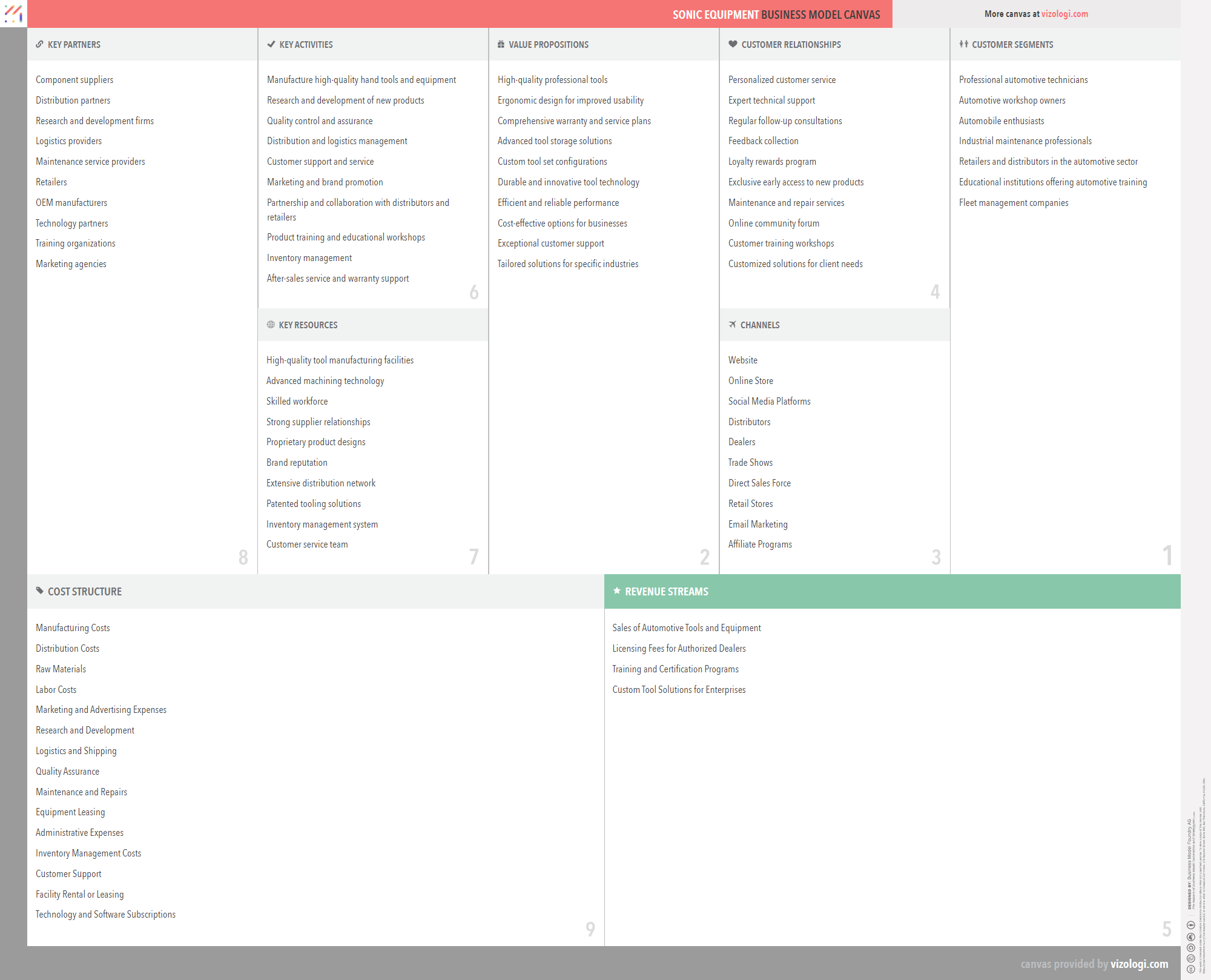
Sonic Equipments' business model canvas
High-quality professional tools, Ergonomic design for improved usability, Comprehensive warranty and service plans, Advanced tool storage so...


Embed code:

- Component suppliers
- Distribution partners
- Research and development firms
- Logistics providers
- Maintenance service providers
- Retailers
- OEM manufacturers
- Technology partners
- Training organizations
- Marketing agencies
- Manufacture high-quality hand tools and equipment
- Research and development of new products
- Quality control and assurance
- Distribution and logistics management
- Customer support and service
- Marketing and brand promotion
- Partnership and collaboration with distributors and retailers
- Product training and educational workshops
- Inventory management
- After-sales service and warranty support
- High-quality tool manufacturing facilities
- Advanced machining technology
- Skilled workforce
- Strong supplier relationships
- Proprietary product designs
- Brand reputation
- Extensive distribution network
- Patented tooling solutions
- Inventory management system
- Customer service team
- High-quality professional tools
- Ergonomic design for improved usability
- Comprehensive warranty and service plans
- Advanced tool storage solutions
- Custom tool set configurations
- Durable and innovative tool technology
- Efficient and reliable performance
- Cost-effective options for businesses
- Exceptional customer support
- Tailored solutions for specific industries
- Personalized customer service
- Expert technical support
- Regular follow-up consultations
- Feedback collection
- Loyalty rewards program
- Exclusive early access to new products
- Maintenance and repair services
- Online community forum
- Customer training workshops
- Customized solutions for client needs
- Professional automotive technicians
- Automotive workshop owners
- Automobile enthusiasts
- Industrial maintenance professionals
- Retailers and distributors in the automotive sector
- Educational institutions offering automotive training
- Fleet management companies
- Website
- Online Store
- Social Media Platforms
- Distributors
- Dealers
- Trade Shows
- Direct Sales Force
- Retail Stores
- Email Marketing
- Affiliate Programs
- Manufacturing Costs
- Distribution Costs
- Raw Materials
- Labor Costs
- Marketing and Advertising Expenses
- Research and Development
- Logistics and Shipping
- Quality Assurance
- Maintenance and Repairs
- Equipment Leasing
- Administrative Expenses
- Inventory Management Costs
- Customer Support
- Facility Rental or Leasing
- Technology and Software Subscriptions
- Sales of Automotive Tools and Equipment
- Licensing Fees for Authorized Dealers
- Training and Certification Programs
- Custom Tool Solutions for Enterprises
Sonic Equipment’s Revenue Model
Sonic Equipment makes money by combining different business models. Below, you will find the list of the different monetization strategies identified for this company:
Sonic Equipment makes money by combining different business models. Below, you will find the list of the different monetization strategies identified for this company:
- Direct selling
- Make and distribute
- eCommerce
- Niche retail
- Licensing
- Certification and endorsement
- Best in class services
- Customer loyalty
- Customer relationship
- Product innovation
- Solution provider
- Experience selling
Analytics
Market Overview
Sonic Equipment’s Case Study
When we delve into the world of premium automotive tools and equipment, Sonic Equipment stands as a beacon of excellence. This case study explores the journey of Sonic Equipment, a pioneer in the industrial sec...
Sonic Equipment's CASE STUDY
When we delve into the world of premium automotive tools and equipment, Sonic Equipment stands as a beacon of excellence. This case study explores the journey of Sonic Equipment, a pioneer in the industrial sector that has reshaped how professional mechanics and DIY enthusiasts approach automotive repair and maintenance tasks. Originating from the Netherlands, Sonic Equipment’s strategic blend of innovation, customer engagement, and quality sets it apart in a crowded market.
Origin and Expansion: Building a Global Presence
Founded in 2004 in Aalten, Gelderland, Sonic Equipment began its operations with a vision to provide the finest automotive hand tools worldwide. What started as a local business quickly spread its roots internationally. According to reports from 2023, the global automotive hand tools market is valued at USD 21.5 billion, with Sonic Equipment playing a significant role in this growth trajectory (source: Market Research Data). By understanding market needs and focusing on precision engineering, Sonic Equipment offers an array of products that ensure both durability and efficiency.
Strategic Innovations: The Key to Sonic Equipment’s Success
One of the standout attributes of Sonic Equipment is its unwavering commitment to innovation. According to innovation consultancy Inkwood Research, industries that prioritize R&D can increase their market share by up to 20%. Riding this wave, Sonic consistently invests in research and development to stay ahead of industry trends. The integration of user feedback is pivotal. Customers highlight the combination of aesthetics and practicality as significant factors contributing to their brand loyalty. Using advanced technology and engaging directly with the end-user, Sonic cultivates a relationship that transforms casual customers into brand advocates.
Unique Selling Proposition: The Sonic Experience
Sonic’s products are known not just for their functionality but also for the experience they offer. As Harvard Business School professor Gerald Zaltman explains, over 95% of purchasing decisions are influenced by the subconscious mind. Thus, by focusing on the emotional and psychological aspects — such as design aesthetics and badge value — Sonic Equipment fosters a deep sense of affiliation and belonging among users. Notably, professionals and hobbyists alike praise Sonic for delivering tools that increase productivity, organizing workspaces efficiently and ensuring that quality standards are met consistently.
Customer Engagement and Market Reach
Understanding and responding to customer needs is at the core of Sonic’s business model. Despite its classification as a beginner in digital maturity, Sonic excels in direct selling and eCommerce strategies, creating a niche market where customers feel valued and heard. The Harvard Business Review highlights that companies with high customer engagement see a 63% lower churn rate than those with low engagement levels (HBR, 2023). Sonic’s strategy combines direct sales with global partnerships—thereby expanding its reach through authorized distributors and retailers and ensuring a steady revenue stream.
Revenue Model: Direct Sales and Strategic Partnerships
Sonic Equipment’s revenue model primarily revolves around the direct sale of its comprehensive product range to diverse segments, including automotive shops, dealerships, and educational institutions. By leveraging a network of authorized distributors, Sonic not only boosts its market presence but also diversifies its revenue channels. While the company does not extensively rely on subscription models, customer loyalty is embedded within its ethos. Through emphasizing product longevity, Samsung not only secures repeat purchases but also garners trust and loyalty from its clientele.
Insights into the Sonic Differentiator
What makes Sonic Equipment special isn't just its high-quality tools but the company’s holistic approach to business strategy. By integrating product innovation, exceptional customer service, and strategic global partnerships, Sonic harmonizes functionality with user-centric design.
In conclusion, Sonic Equipment's remarkable journey illustrates the power of strategic foresight, innovation, and robust customer relationships in achieving global success. For companies in the industrial sector looking to emulate such success, focusing on user needs, consistent quality, and embracing technological advancements will undeniably prove to be fruitful pathways.
Sonic Equipment’s Related Competitors
Compare patterns with Snap-On, Denso, Continental...




+100 Business Book Summaries
We’ve distilled the wisdom of influential business books for you.
Zero to One by Peter Thiel.
The Infinite Game by Simon Sinek.
Blue Ocean Strategy by W. Chan.
…