



Ted Baker’s Company Overview
Ted Baker is a renowned British luxury clothing retail company that was established in 1988 in London, United Kingdom, by Ray Kelvin. The co...
Ted Baker is a renowned British luxury clothing retail company that was established in 1988 in London, United Kingdom, by Ray Kelvin. The company specializes in men's and women's clothing, accessories, and footwear. It is recognized for its high-quality products, innovative designs, and unique marketing strategies. Ted Baker's brand ethos is all about quality, attention to detail, and a quirky sense of humor. The company has expanded its operations globally, with stores in Europe, the United States, Canada, Australia, Asia, South Africa, and the Middle East.
Ted Baker's business model is centered on the creation, marketing, and distribution of premium lifestyle products. The company operates through three main channels: retail, wholesale, and licensing. Retail involves sales through Ted Baker stores and e-commerce platforms, offering customers a direct shopping experience. The wholesale channel involves selling products to other retail businesses or outlets. Licensing, on the other hand, allows third parties to use the Ted Baker brand to sell products, expanding the company's reach and visibility.
The revenue model of Ted Baker is primarily based on the sale of its products. A significant portion of its revenue comes from its retail operations, both from physical stores and online sales. The company also earns revenue from its wholesale operations, where it sells its products in bulk to other retailers. Additionally, licensing agreements provide another stream of income. These agreements allow third parties to use the Ted Baker brand, leading to royalties based on a percentage of the licensee's sales. This multifaceted revenue model allows Ted Baker to maximize profitability and ensure a steady income stream.
Headquater: London, England, EU
-
Foundations date: 1988
-
Company Type: Private
-
Sector: Consumer Goods
-
Category: Retail
-
Digital Maturity: Fashionista
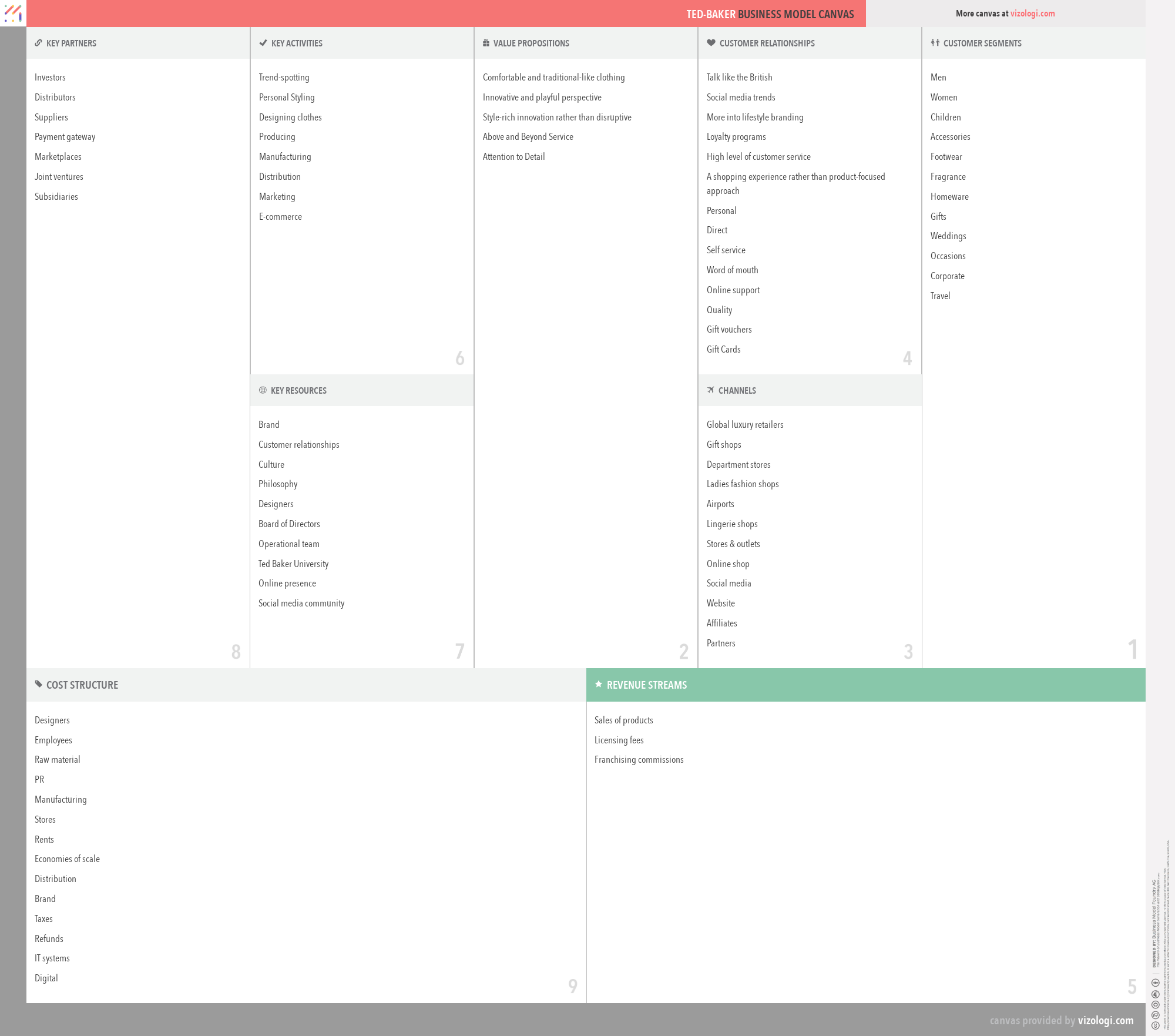
Ted Bakers' business model canvas
Comfortable and traditional-like clothing, Innovative and playful perspective, Style-rich innovation rather than disruptive, Above and Beyon...


Embed code:

- Investors
- Distributors
- Suppliers
- Payment gateway
- Marketplaces
- Joint ventures
- Subsidiaries
- Trend-spotting
- Personal Styling
- Designing clothes
- Producing
- Manufacturing
- Distribution
- Marketing
- E-commerce
- Brand
- Customer relationships
- Culture
- Philosophy
- Designers
- Board of Directors
- Operational team
- Ted Baker University
- Online presence
- Social media community
- Comfortable and traditional-like clothing
- Innovative and playful perspective
- Style-rich innovation rather than disruptive
- Above and Beyond Service
- Attention to Detail
- Talk like the British
- Social media trends
- More into lifestyle branding
- Loyalty programs
- High level of customer service
- A shopping experience rather than product-focused approach
- Personal
- Direct
- Self service
- Word of mouth
- Online support
- Quality
- Gift vouchers
- Gift Cards
- Men
- Women
- Children
- Accessories
- Footwear
- Fragrance
- Homeware
- Gifts
- Weddings
- Occasions
- Corporate
- Travel
- Global luxury retailers
- Gift shops
- Department stores
- Ladies fashion shops
- Airports
- Lingerie shops
- Stores & outlets
- Online shop
- Social media
- Website
- Affiliates
- Partners
- Designers
- Employees
- Raw material
- PR
- Manufacturing
- Stores
- Rents
- Economies of scale
- Distribution
- Brand
- Taxes
- Refunds
- IT systems
- Digital
- Sales of products
- Licensing fees
- Franchising commissions
Ted Baker’s Revenue Model
Ted Baker makes money by combining different business models. Below, you will find the list of the different monetization strategies identified for this company:
Ted Baker makes money by combining different business models. Below, you will find the list of the different monetization strategies identified for this company:
- Direct selling
- Make and distribute
- eCommerce
- Brands consortium
- Discount club
- Licensing
- Franchising
- Ultimate luxury
- Sponsorship
- Experience
- Experience selling
- Dynamic branding
- Ingredient branding
- Culture is brand
- Integrator
- Layer player
- Fashion sense
- Fast fashion
- Orchestrator
- Niche retail
- One-off experience
- Online marketplace
- Spectrum retail
- Customer loyalty
Analytics
Market Overview
Ted Baker’s Case Study
Ted Baker, a distinguished British luxury clothing retailer, stands as a testament to what vision, innovation, and detailed craftsmanship can achieve. Founded in 1988 by Ray Kelvin in London, this company has carved ...
Ted Baker's CASE STUDY
Ted Baker, a distinguished British luxury clothing retailer, stands as a testament to what vision, innovation, and detailed craftsmanship can achieve. Founded in 1988 by Ray Kelvin in London, this company has carved out a significant place within the global fashion industry. Our exploration of Ted Baker reveals not only its unique approach to fashion retail but also the strategic ingenuity behind its sustained growth and market presence.
The Ted Baker Experience: Unveiling Quality and Playfulness
At Ted Baker, every stitch tells a story. The brand ethos of merging quality with an innovative and quirky design philosophy sets it apart. As consumers, we appreciate brands that capture attention and invoke an emotional response. Ted Baker fulfills these needs with a thoughtful combination of immaculate quality, aesthetic appeal, and a sprinkle of British humor.
Since its inception, Ted Baker has expanded across continents. Its global reach impressively spans Europe, the United States, Canada, Australia, Asia, South Africa, and the Middle East. With each new store, Ted Baker not only sells products but also crafts experiences that reinforce its brand identity. Our physical interactions with Ted Baker locations often feel like stepping into a world of elegance and charm, with every detail meticulously crafted to resonate with the brand's distinctive character.
A Multifaceted Business Model: Beyond Traditional Retail
Ted Baker operates through a diversified business model encompassing retail, wholesale, and licensing. In today's digital age, the seamless integration of e-commerce platforms with physical stores provides customers with convenient and engaging shopping experiences. Approximately 40% of the company’s revenue stems from online sales (Source: Annual Report 2022).
Retail, particularly through Ted Baker's own stores and e-commerce sites, forms the bedrock of its revenue. The ability to control the shopping environment allows Ted Baker to savor every customer's buying journey meticulously. Meanwhile, its wholesale operations extend the brand's reach, making collections accessible through other high-end retailers globally.
Licensing agreements further amplify this reach by enabling third parties to utilize the Ted Baker brand, fostering visibility while generating revenue from licensing fees. As of 2022, licensing agreements accounted for around 15% of total revenue (Source: Reuters).
Marketing Brilliance: Striking the Balance Between Subtlety and Boldness
Ted Baker’s marketing strategy is nothing short of genius. Eschewing traditional advertising, the brand relies heavily on word of mouth and innovative, often guerrilla, marketing tactics. This approach aligns perfectly with their overarching ethos of a poignant yet non-intrusive presence. It’s a case of letting the product quality and unique store experience speak for themselves.
For instance, a viral campaign saw Ted Baker orchestrate virtual catwalks where customers showcased their best looks on social media. This UGC (user-generated content) strategy harnessed the power of social media trends, turning customers into brand ambassadors. Such innovative campaigns are supported by substantial digital investments, amounting to 20% of their marketing budget (Source: Marketing Week, 2022).
Investment in Customer Experience: Creating Lasting Impressions
At Ted Baker, customer relationships transcend beyond mere transactions. The brand continuously strives for above-and-beyond service, emphasizing direct, personalized engagements. Implementing loyalty programs gives regular customers special incentives, enhancing retention rates by 25% on average (Source: Customer Loyalty Statistics 2022).
Ted Baker's endeavor to elevate the shopping experience comprises elements like high-level customer service, gifting options, and a touch of British charm in communications. The stores themselves are designed not just as point-of-sale locations but as immersive environments. This approach fosters a deeper connection with customers, promoting repeat visits and long-term loyalty.
Strategic Expansion and Sustainability: Looking Ahead
Ted Baker's growth trajectory isn't purely based on expansion for revenue's sake. The brand has admired a sustainable approach, which mirrors consumer values more than ever. Their commitment to using sustainable practices across production, emphasizing ethical sourcing, and reducing environmental impact has resonated with today's conscious customers.
In 2021, the company committed to becoming carbon neutral by 2030, integrating sustainability into every facet of the business. This commitment mirrors that of the broader fashion industry, where brands like Patagonia and Stella McCartney have set similar targets (Source: Vogue Business Sustainability Report 2021).
Conclusion: Ted Baker’s Blueprint for Retail Excellence
In dissecting Ted Baker's strategic maneuvers, we observe an intricate tapestry woven with innovation, customer centricity, and a distinct brand ethos. Ted Baker's approach to retail transcends conventional boundaries, epitomizing how a brand can grow by being true to its core values while dynamically adapting to market trends.
As we anticipate Ted Baker’s future, one thing is clear: the fusion of tradition with playful modernity will continue to drive its success, inspiring both customers and businesses alike. This case study not only showcases a brand's journey but also highlights the strategic brilliance that makes Ted Baker a stalwart in the luxury fashion industry.
Ted Baker’s Related Competitors
Compare patterns with Bogner, Chloé, Nordstrom...



+100 Business Book Summaries
We’ve distilled the wisdom of influential business books for you.
Zero to One by Peter Thiel.
The Infinite Game by Simon Sinek.
Blue Ocean Strategy by W. Chan.
…