



Bambrew’s Company Overview
Bambrew is an innovative and eco-conscious company that specializes in the manufacturing and distribution of reusable bamboo products, with ...
Bambrew is an innovative and eco-conscious company that specializes in the manufacturing and distribution of reusable bamboo products, with a primary focus on coffee cups. The company, established with a mission to reduce plastic waste and promote sustainability, has been successful in creating a range of products that are not only environmentally friendly but also stylish and functional. Bambrew's products are made from organically grown bamboo, a renewable resource that is both durable and biodegradable. The company's dedication to quality and sustainability sets it apart in the market, making it a preferred choice for consumers who are conscious about their impact on the environment.
Business Model:
Bambrew operates on a direct-to-consumer business model, leveraging e-commerce platforms to sell its products. This allows the company to reach a global customer base, offering its eco-friendly products to consumers around the world. Bambrew also partners with coffee shops and retailers, supplying them with branded reusable cups that not only reduce waste but also serve as a form of advertising. The company's commitment to sustainability extends to its supply chain, sourcing bamboo from responsible and sustainable sources and ensuring all aspects of production are as eco-friendly as possible.
Revenue Model:
Bambrew's primary source of revenue comes from the sale of its bamboo products. The company sells its products directly to consumers through its online store, as well as through retail partners. It also offers a B2B model, supplying businesses with custom-branded products, which provides an additional revenue stream. Furthermore, Bambrew has a subscription model where customers can receive new products on a regular basis, ensuring a consistent and predictable revenue flow. The company's focus on quality and sustainability also allows it to command a premium price for its products, contributing to its profitability.
Headquater: Bengaluru, Karnataka, India
-
Foundations date: 2016
-
Company Type: Social enterprise
-
Sector: Consumer Goods
-
Category: Food & Beverages
-
Digital Maturity: Digirati
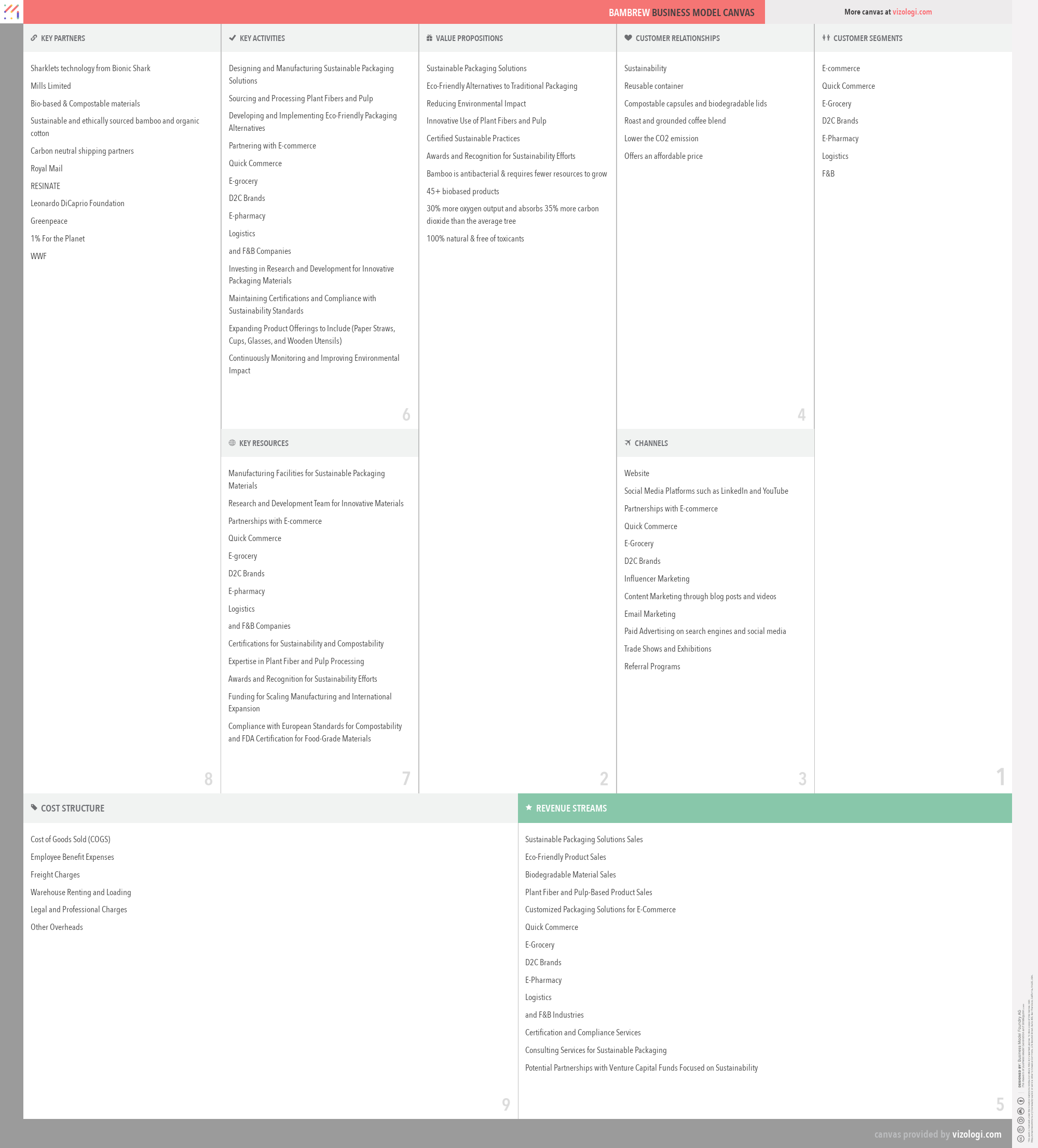
Bambrews' business model canvas
Sustainable Packaging Solutions, Eco-Friendly Alternatives to Traditional Packaging, Reducing Environmental Impact, Innovative Use of Plant ...


Embed code:

- Sharklets technology from Bionic Shark
- Mills Limited
- Bio-based & Compostable materials
- Sustainable and ethically sourced bamboo and organic cotton
- Carbon neutral shipping partners
- Royal Mail
- RESINATE
- Leonardo DiCaprio Foundation
- Greenpeace
- 1% For the Planet
- WWF
- Designing and Manufacturing Sustainable Packaging Solutions
- Sourcing and Processing Plant Fibers and Pulp
- Developing and Implementing Eco-Friendly Packaging Alternatives
- Partnering with E-commerce
- Quick Commerce
- E-grocery
- D2C Brands
- E-pharmacy
- Logistics
- and F&B Companies
- Investing in Research and Development for Innovative Packaging Materials
- Maintaining Certifications and Compliance with Sustainability Standards
- Expanding Product Offerings to Include (Paper Straws, Cups, Glasses, and Wooden Utensils)
- Continuously Monitoring and Improving Environmental Impact
- Manufacturing Facilities for Sustainable Packaging Materials
- Research and Development Team for Innovative Materials
- Partnerships with E-commerce
- Quick Commerce
- E-grocery
- D2C Brands
- E-pharmacy
- Logistics
- and F&B Companies
- Certifications for Sustainability and Compostability
- Expertise in Plant Fiber and Pulp Processing
- Awards and Recognition for Sustainability Efforts
- Funding for Scaling Manufacturing and International Expansion
- Compliance with European Standards for Compostability and FDA Certification for Food-Grade Materials
- Sustainable Packaging Solutions
- Eco-Friendly Alternatives to Traditional Packaging
- Reducing Environmental Impact
- Innovative Use of Plant Fibers and Pulp
- Certified Sustainable Practices
- Awards and Recognition for Sustainability Efforts
- Bamboo is antibacterial & requires fewer resources to grow
- 45+ biobased products
- 30% more oxygen output and absorbs 35% more carbon dioxide than the average tree
- 100% natural & free of toxicants
- Sustainability
- Reusable container
- Compostable capsules and biodegradable lids
- Roast and grounded coffee blend
- Lower the CO2 emission
- Offers an affordable price
- E-commerce
- Quick Commerce
- E-Grocery
- D2C Brands
- E-Pharmacy
- Logistics
- F&B
- Website
- Social Media Platforms such as LinkedIn and YouTube
- Partnerships with E-commerce
- Quick Commerce
- E-Grocery
- D2C Brands
- Influencer Marketing
- Content Marketing through blog posts and videos
- Email Marketing
- Paid Advertising on search engines and social media
- Trade Shows and Exhibitions
- Referral Programs
- Cost of Goods Sold (COGS)
- Employee Benefit Expenses
- Freight Charges
- Warehouse Renting and Loading
- Legal and Professional Charges
- Other Overheads
- Sustainable Packaging Solutions Sales
- Eco-Friendly Product Sales
- Biodegradable Material Sales
- Plant Fiber and Pulp-Based Product Sales
- Customized Packaging Solutions for E-Commerce
- Quick Commerce
- E-Grocery
- D2C Brands
- E-Pharmacy
- Logistics
- and F&B Industries
- Certification and Compliance Services
- Consulting Services for Sustainable Packaging
- Potential Partnerships with Venture Capital Funds Focused on Sustainability
Bambrew’s Revenue Model
Bambrew makes money by combining different business models. Below, you will find the list of the different monetization strategies identified for this company:
Bambrew makes money by combining different business models. Below, you will find the list of the different monetization strategies identified for this company:
- Direct selling
- Solution provider
- Embedded social enterprises
- Sustainability-focused
- Collaborative production
- Open innovation
- Experience selling
- Certification and endorsement
- Trash to cash
- Product innovation
- Corporate innovation
- Blue ocean strategy
- Social stakeholder
- Take the wheel
Analytics
Market Overview
Bambrew’s Case Study
It was the year 2016 when we embarked on a journey that would transform the very core of the consumer goods sector, particularly within the food and beverages category. Bambrew, an innovative and eco-conscious company ...
Bambrew's CASE STUDY
It was the year 2016 when we embarked on a journey that would transform the very core of the consumer goods sector, particularly within the food and beverages category. Bambrew, an innovative and eco-conscious company headquartered in Bengaluru, Karnataka, India, set out with a compelling mission: to combat the pervasive problem of plastic waste by offering sustainable, stylish, and functional alternatives.
Our foray into the world of bamboo-based products started with something as simple and ubiquitous as a coffee cup. As social entrepreneurs deeply invested in the future of our planet, our founders recognized bamboo as a renewable resource that was both durable and biodegradable. This realization segued into what is Bambrew today—a company shaking up the market by providing eco-friendly substitutions to traditional plastic products.
The Genesis of Bambrew
From the get-go, Bambrew positioned itself as a leader in sustainability. The versatile bamboo, known for being antibacterial and requiring fewer resources to grow, became the core material for our products. Remarkably, bamboo emits 30% more oxygen and absorbs 35% more carbon dioxide than the average tree, which aligns perfectly with our sustainability goals.
Over six years, we expanded from being just a manufacturer of reusable coffee cups to a brand that offers over 45 biobased products. These include everything from bamboo straws to wooden utensils, each designed to minimize environmental impact. Our journey has been powered by conscious decisions at every juncture—right from ethically sourcing bamboo and organic cotton to ensuring carbon-neutral shipping.
Disrupting the Market with a Unique Business Model
Bambrew’s business model is a testament to our commitment to sustainability and direct consumer engagement. Our direct-to-consumer approach, primarily through e-commerce platforms, means that we can reach a global customer base effortlessly. This strategy is augmented by partnerships with coffee shops and retailers who find value in branded reusable cups that serve dual purposes—reducing waste and acting as walking advertisements.
Our revenue model thrives on diversity. Both B2C and B2B channels are well integrated, providing a balanced and consistent revenue stream. Besides the direct online sales, our B2B model allows us to offer customized, branded products to businesses. Additionally, our subscription model ensures recurring revenue while keeping our customers engaged and satisfied with regular new offerings.
A Path Paved by Data and Impact
Our focus on sustainability has garnered us credibility and a premium market positioning. According to a 2022 report by the Ellen MacArthur Foundation, moving to a circular economy model could generate $4.5 trillion in global economic benefits by 2030. Bambrew is a microcosm of this macro trend, diligent in our pursuit to reduce plastic waste.[Source: Ellen MacArthur Foundation, 2022]
Recently, our company was featured in a study by McKinsey & Company highlighting how consumer interest in sustainable products has grown by more than 50% over the past decade.[Source: McKinsey & Company, 2022] This is indicative of the potential market we are tapping into and the social impact we are making.
Holistic Customer Experience
Bambrew’s value proposition isn’t merely about selling products; it’s about offering experiences. Our customers, split into e-commerce, quick commerce, e-grocery, D2C brands, e-pharmacy, logistics, and F&B segments, value quality, variety, and sensory appeal. These functional needs are consistently met with our versatile product line.
Psychologist Abraham Maslow’s hierarchy of needs indicates that after basic physiological needs, humans yearn for safety, belonging, and self-fulfillment. Bambrew taps into these layers by creating products that contribute to a safer environment and offer a sense of belonging to a community of eco-conscious consumers. Each purchase is a step towards reducing the world's carbon footprint—a socially impactful decision that aligns with emotional and life-changing customer needs.
Harnessing Collaborative Innovation and Sustainability
One of our fundamental pillars is our collaborative approach to innovation. We have partnered with industry leaders like Sharklets technology from Bionic Shark and sustainable suppliers like Mills Limited. Organizations like the Leonardo DiCaprio Foundation and WWF lend credibility to our mission through endorsements and partnerships.
This synergy extends into our operations. Our manufacturing units specialize in sustainable packaging materials, supported by a robust R&D team focused on pioneering eco-friendly alternatives. Being certified by European standards for compostability and the FDA for food-grade materials assures our customers of our commitment to quality and compliance.
Sustainability at the Core of Operations
Our commitment to sustainability includes every business pattern imaginable, from direct selling to embedded social enterprises. We function as a solution provider, always seeking to reduce our environmental impact. Our innovative use of plant fibers and pulp, and the move towards compostable and biodegradable materials, substantially contribute to waste reduction.
Bambrew’s financial focus is as sharp as our ecological one. From managing our cost structure, which involves everything from employee benefits to freight charges, to exploring diverse revenue streams like consulting services for sustainable packaging, every aspect is meticulously planned.
Impact and Future Outlook
So, where does Bambrew go from here? The future looks promising as we plan on scaling our manufacturing capabilities and aim for international expansion. With growing recognition from sustainability awards and heightened consumer awareness, our potential for growth seems exponential.
Our journey, backed by strong data and substantial impact, underlines the possibility of harmonizing business success with ecological responsibility. Bambrew is more than a company; it’s a movement towards a greener and more sustainable future. In a world grappling with environmental challenges, our products offer new hope, one bamboo coffee cup at a time.
In conclusion, Bambrew's distinctive approach, robust business model, and unwavering commitment to sustainability make it an exemplary case study in the realm of eco-friendly consumer goods. As we forge ahead, our ethos remains clear—creating beautiful, functional, and sustainable products that help save our planet.
[Ellen MacArthur Foundation, McKinsey & Company referenced within the context of the article provide industry benchmarks and signify our alignment with global sustainability trends.]
Bambrew’s Related Competitors
Compare patterns with ReVeg Fruit, Anheuser-Busch InBev, Heineken Holding...



+100 Business Book Summaries
We’ve distilled the wisdom of influential business books for you.
Zero to One by Peter Thiel.
The Infinite Game by Simon Sinek.
Blue Ocean Strategy by W. Chan.
…